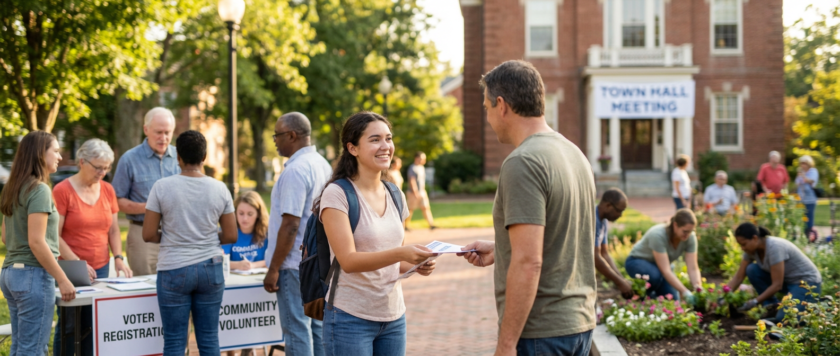
How American Civic Life Really Works
When Alexis de Tocqueville toured America in the 1830s, he marveled at something remarkable: ordinary citizens gathering in churches, barns, and town squares to solve problems together. These weren’t politicians or wealthy elites, but farmers, shopkeepers, and craftspeople who understood that democracy required their active participation. Tocqueville called it “the art of association,” and it became the foundation of American civic culture.
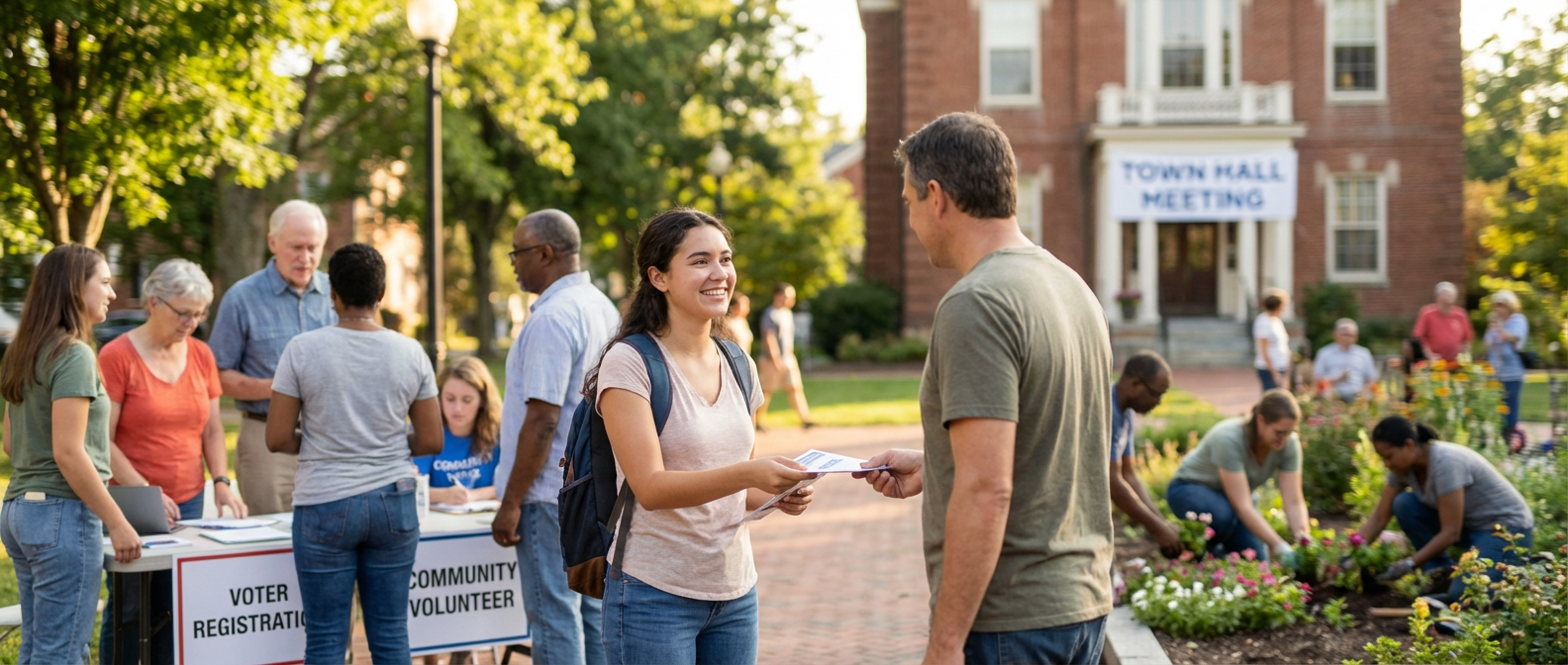
Today’s civic world looks completely different, but the basic principle stays the same. Whether you’re attending a school board meeting via Zoom or organizing neighbors through a Facebook group, you’re participating in the same democratic tradition that has sustained American communities for nearly two centuries. The tools have changed, but the basic mechanics of civic engagement work the same way they did when your great-great-grandparents gathered to decide whether their town needed a new schoolhouse.
This historical connection matters because it reveals something important: civic engagement isn’t some complex political science that requires advanced degrees to master. It’s a set of learnable skills that millions of Americans have practiced successfully, often starting with concerns as simple as fixing a pothole or improving a local park. The difference between then and now isn’t how hard participation is, but the sheer number of ways modern citizens can get involved.

Start Small: Why Local Issues Make the Best Training Ground
The most effective civic movements in American history started small and local before expanding outward. The Progressive Era reformers who transformed American cities in the early 1900s didn’t begin by trying to change federal policy. They focused on immediate, concrete problems: unsafe drinking water, terrible sanitation, dangerous working conditions in local factories. Jane Addams didn’t set out to become a national figure when she opened Hull House in Chicago. She was responding to the specific needs of her immigrant neighbors.
This pattern offers a practical roadmap for modern civic engagement. Start with the issues that directly affect your daily life and the lives of people around you. Is there a dangerous intersection in your neighborhood that needs a traffic light? Are local school board decisions affecting your children’s education? Is your city council considering changes to zoning laws that might impact your community’s character? These hyperlocal concerns provide the easiest entry points for civic participation because they require less specialized knowledge and offer more immediate opportunities for real impact.
What I love about this approach is its educational value. When you research how traffic light installation works in your city, you inevitably learn about municipal budgeting, public works departments, and the relationship between city and county government. Each local issue you engage with builds your understanding of how government functions, preparing you for more complex challenges. The activists who successfully pushed for civil rights legislation in the 1960s had typically spent years working on local voter registration drives and community organizing efforts that taught them essential skills.
Modern technology has dramatically expanded the reach of local organizing while keeping its basic advantages. Nextdoor and similar neighborhood platforms allow you to identify like-minded neighbors who share your concerns about local issues. Municipal websites now provide amazing access to city council agendas, budget documents, and public records that would have required days of courthouse visits just a generation ago. The same principles that made town hall democracy work in colonial New England can now operate at neighborhood scale with citywide coordination.
Beyond Voting: How Real Influence Actually Works
Voting is the most visible form of civic participation, but American history shows that the most significant changes usually happen between elections through sustained citizen engagement. The abolition movement, women’s suffrage, labor organizing, and civil rights all succeeded primarily through persistent advocacy, coalition building, and strategic pressure applied over years or decades. Frederick Douglass didn’t change minds about slavery through a single speech. He built influence through consistent public education, strategic alliances, and relentless organizing.
Understanding this historical pattern helps clarify what modern civic engagement actually looks like in practice. Regular attendance at city council meetings matters more than passionate social media posts because it shows sustained commitment and builds relationships with decision makers. Writing thoughtful letters to elected officials carries more weight than signing online petitions because it requires genuine investment of time and effort. Volunteering for local campaigns or civic organizations provides more leverage than donating money because it contributes human energy to movements that depend on volunteer labor.
The most underused form of civic engagement might be the simple act of showing up consistently. When you attend multiple school board meetings or planning commission hearings, you begin to understand the personalities, procedures, and political dynamics that shape decisions. You learn which arguments work with which board members, when public input actually influences outcomes, and how to frame concerns in language that bureaucrats and elected officials find compelling. This knowledge builds over time, making you increasingly effective as an advocate for your community’s interests.
Building relationships with staff members in city departments, county offices, and school districts can prove just as valuable as connections with elected officials. These civil servants often have deep institutional knowledge and can provide crucial guidance on navigating bureaucratic processes. They also tend to serve longer than elected officials, providing continuity as political leadership changes. The settlement house workers of the early 1900s understood this principle naturally, building partnerships with sympathetic bureaucrats who helped implement reforms from within government structures.
The Information Advantage: Research as Your Secret Weapon
One of the biggest differences between successful and unsuccessful civic movements throughout American history has been their mastery of relevant information. The muckraking journalists who exposed urban corruption in the early 1900s succeeded because they methodically documented problems with specific data, names, and dates. Civil rights organizers in the 1950s and 1960s carefully researched local voting laws, school funding formulas, and employment practices to build airtight cases for change.
Modern citizens have incredible access to government information, but this advantage only matters if you know how to find and use it effectively. Every state has freedom of information laws that require government agencies to provide public records upon request. Most municipalities publish detailed budgets, meeting minutes, and policy documents online. Federal databases contain everything from campaign finance records to environmental compliance data that can shed light on local issues.
Learning to navigate these information systems transforms you from an occasional participant into a genuinely informed advocate. When you can cite specific budget line items, reference previous city council decisions, or point to comparable policies in neighboring jurisdictions, your arguments carry much more weight with decision makers. This research capability also helps you spot strategic opportunities that less informed advocates might miss. Understanding when budget decisions get made, which committees have authority over specific issues, or how public comment periods actually influence policy gives you significant advantages in timing and targeting your advocacy efforts.
The key to developing research skills is starting with simple questions about issues you already care about and gradually building your knowledge base. If you’re concerned about local school funding, begin by reviewing your district’s latest budget and comparing per-pupil spending with neighboring districts. If traffic safety worries you, research how your city’s traffic engineering department makes decisions about signal timing and crosswalk installation. Each investigation teaches you more about how local government works while building expertise on issues that matter to your community.
Building Democracy From the Ground Up
The most encouraging lesson from American civic history is that ordinary people working on ordinary problems have consistently achieved extraordinary changes when they approached civic engagement with patience, persistence, and strategic thinking. The founders of rural electrical cooperatives in the 1930s weren’t policy experts when they started organizing. They were farmers frustrated by private utilities’ refusal to serve sparsely populated areas. The parents who integrated American public schools weren’t constitutional scholars. They were mothers and fathers who wanted better educational opportunities for their children.
What made these successful movements different was their commitment to building lasting institutions rather than simply responding to immediate crises. They created organizations, developed leadership pipelines, and established procedures for sustained engagement that outlasted any individual campaign or controversy. This institutional thinking remains crucial for modern civic engagement because the challenges facing American communities require long-term solutions that span multiple election cycles and involve coordination across different levels of government.
Your own civic engagement journey will likely mirror this historical pattern, beginning with personal concerns and evolving into broader community leadership as you develop skills and relationships. The neighborhood issue that motivates your first city council appearance might eventually lead to serving on a municipal commission, running for local office, or founding an organization that addresses regional challenges. Every significant civic leader in American history started as someone who simply decided to get involved in solving a problem that affected their daily life.
The infrastructure for civic engagement that exists in your community today represents the accumulated efforts of generations of citizens who understood that democracy requires active maintenance. By adding your voice and energy to that tradition, you’re not just addressing immediate concerns but strengthening the civic institutions that will serve future generations. Start wherever you are, with whatever time you can spare, knowing that every small action contributes to something much larger than any individual effort.