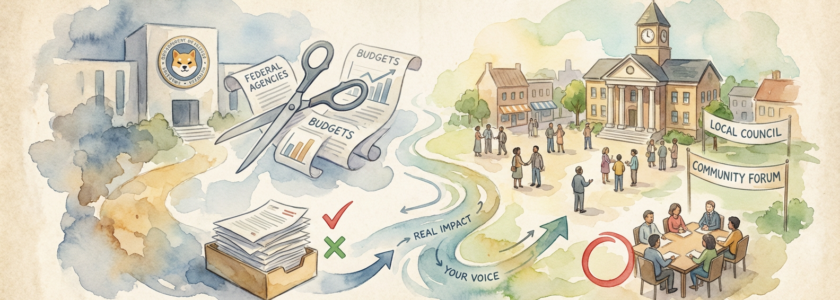
The 2025 DOGE Report Card: What the Department of Government Efficiency Actually Cut, What It Didn’t, and Why Your City Council Is the Real Battleground

The 2025 DOGE Report Card: What the Department of Government Efficiency Actually Cut, What It Didn’t, and Why Your City Council Is the Real Battleground

The Numbers That Sound Big Until You Read The Fine Print

When the Department of Government Efficiency launched in January 2025 under executive order, the headline figures were hard to ignore. Over one trillion dollars in potential federal savings identified by mid-year. That’s a number designed to stop you mid-scroll. It’s designed to feel decisive, transformative, proof that someone finally took a hard look at waste and acted. The only problem is that the Congressional Budget Office, the nonpartisan arbiter of federal spending claims, scored the actually verified savings at a fraction of that estimate. This gap between claimed and confirmed is not a small accounting detail. It’s the first and most important structural lesson: understanding what gets counted as “government efficiency” requires looking past the headline number to the methodology underneath.
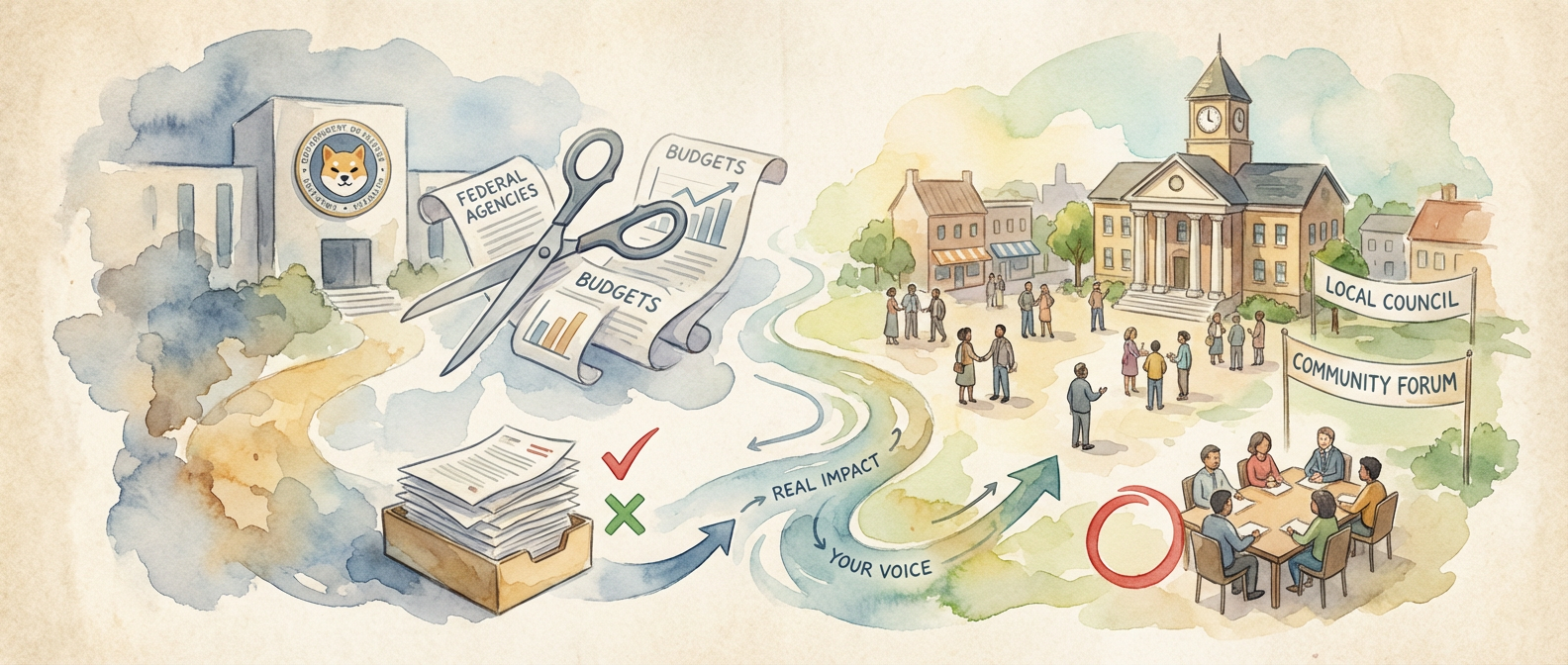
The 2025 DOGE Report Card: What the Department of Government Efficiency Actually Cut, What It Didn't, and Why Your City Council Is the Real Battleground
The 2025 DOGE Report Card: What the Department of Government Efficiency Actually Cut, What It Didn’t, and Why Your City Council Is the Real Battleground

The difference between a trillion-dollar claim and the CBO’s verified figure tells you something crucial about how efficiency initiatives get framed in American political life. When you see those dramatic numbers in your news feed, ask yourself what changed in the real economy. Did your local food bank suddenly have more resources? Did your city’s infrastructure budget expand? This is not cynicism. This is structural analysis. The gap between rhetoric and results exists in how these programs measure success, and understanding that is half the battle in becoming an informed citizen.

Illustration for The 2025 DOGE Report Card: What the Department of Government Efficiency Actually Cut, What It Didn't, and Why Your City Council Is the Real Battleground
Illustration for The 2025 DOGE Report Card: What the Department of Government Efficiency Actually Cut, What It Didn’t, and Why Your City Council Is the Real Battleground

The Federal Workforce Reductions: Where the Rubber Actually Hits the Road

If the trillion-dollar claim is the headline, the federal workforce reductions are where you can actually track change happening. According to Office of Personnel Management data, approximately 75,000 federal employees accepted deferred resignation offers in the first quarter of 2025 alone. That is a real number. Real people left their jobs. That has real consequences. Some of those employees were in administrative roles where redundancy existed. Some of them were field agents, inspectors, grant administrators, and caseworkers whose positions directly affected service delivery. The problem with broad workforce reduction targets is that they are structurally indifferent to which category you’re cutting from. When you set a percentage-based reduction goal across an entire agency, you lose the ability to preserve critical functions while eliminating genuine waste.

The Congressional Budget Office Federal Workforce Analysis 2025 provides useful context here. Not all federal positions are created equal. A clerk processing paperwork operates in a different role than a Social Security disability examiner processing claims for people waiting years in the queue. Wholesale reductions do not distinguish between these roles. They work like a river flood. Water doesn’t know which buildings were built to code. It simply goes where gravity allows. In this case, gravity meant that many localities lost the human infrastructure required to administer federal programs, regardless of whether those programs themselves were efficient or not.

The Cascade Effect: Federal Cuts Become Your City’s Problem

This is where local government enters the story, and where your attention becomes genuinely urgent. The National Association of Counties documented that federal grant eliminations tied to DOGE reviews forced at least 23 states to restructure local social service delivery programs in 2025. Think about what that sentence actually means. It means that somewhere around the country, a county board had to sit down and recalculate what services they could provide their residents because the federal funds those services relied on disappeared. It means difficult conversations about whether to cut services, raise taxes, or reallocate existing budgets. It means your city council and county commissioners suddenly inherited problems that originated from decisions made 2,000 miles away.

Budget officers in Denver, Columbus, and Memphis went public with the specifics. Mid-cycle funding gaps ranging from 40 million dollars to 180 million dollars directly linked to federal program disruptions. These are not theoretical numbers. These are gaps that force real choices. Do you cut bus service? Close recreation centers? Reduce police response times? Freeze hiring for critical positions? There’s a real irony here. An efficiency initiative at the federal level became an inefficiency crisis at the local level. It’s the classic case of how systems-level problems require systems-level thinking, and when you apply a hammer at the top, the nails get driven down to the foundation.

What The Public Actually Feels: The Gap Between Belief and Experience

A Pew Research Center survey from October 2025 captured something important about how Americans are processing this. Fifty-four percent believed DOGE had some or significant impact on government waste. That is majority sentiment. That matters. But only 31 percent said federal services in their community had improved. This gap is telling you that citizens accept the theoretical case for efficiency while observing no practical benefit in their daily lives. They are watching their local government scramble to fill budget gaps. They are seeing community services disrupted. And they are being asked to believe this is all part of a coherent plan.

This gap between belief and experience is the central political fact of the moment. It suggests that efficiency narratives, no matter how well intentioned, must eventually reckon with whether they produce better service delivery at the place where citizens actually experience government. A more efficient bureaucracy that delivers less is not efficiently organized. It is differently organized, in a way that transfers burden to other actors. Whether that transfer is justified depends entirely on whether those other actors have the capacity to absorb it. Most city councils do not.

Your City Council Is Now the Real Battleground

This is where you come in, and where your attention to local politics becomes not just civically virtuous but practically necessary. The decisions that will determine whether your community emerges from this period with better service delivery or reduced service delivery are happening in city council chambers and county commission meetings. These are the venues where budget amendments get proposed. These are the meetings where you can actually understand how federal policy changes translate into local consequences. And these are the places where your voice still has proportionally more weight than it does in Washington.

I want to be direct about this. Reading about DOGE policy at the national level is useful for understanding the broader context. But understanding how that policy lands in your specific municipality requires doing the harder work of local research. Look at your city budget. Find the line items that were previously federally funded. Track which programs lost money. Show up to budget hearings. Ask your representatives what they are doing to address the gaps. This is not partisan work. This is structural work. Understanding how your government actually functions, and where the pressure points are, gives you the information you need to advocate effectively for what your community needs.

The DOGE initiative will be evaluated by historians and economists for decades. But you do not need to wait for that assessment. You can evaluate it right now by looking at whether your community’s schools, social services, and infrastructure are performing better or worse than they were before. That is the real report card. And the only people who can complete it are the ones paying attention to what your local officials are actually doing about it.


The 2025 Tariff Reckoning: Why Trump’s Trade Gambit Is Reshaping Everything We Thought We Knew About Global Economics

The April Order That Changed the Game

Let me walk you through what happened in April 2025, because understanding the mechanics matters more than accepting the headlines. The Trump administration issued an executive order imposing a 10 percent universal baseline tariff on essentially all imports entering the United States. This wasn’t casual policy. It was deliberate architecture. But here’s where it gets interesting: the order also authorized targeted tariff rates climbing as high as 145 percent on Chinese goods, creating a tiered system that made China the primary pressure point while establishing a floor for everyone else.

Now, before you dismiss this as pure protectionism, let me be fair to the administration’s framing. They argued this approach would incentivize domestic manufacturing, strengthen supply chain resilience, and recalibrate what they viewed as decades of unfavorable trade imbalances. These aren’t unreasonable concerns. Manufacturing employment matters. Supply chain vulnerability is real. The question wasn’t whether the concerns were valid. The question became whether this particular tool would solve them or create different problems.

What Happened to Global Growth When America Raised Its Wall

By October 2025, the International Monetary Fund released its World Economic Outlook and revised global growth projections downward to 2.8 percent for the year. That’s meaningful contraction from prior estimates. The IMF specifically identified U.S.-China trade fragmentation as a primary drag on growth. You can read their analysis in the IMF World Economic Outlook October 2025, and what strikes you immediately is how interconnected everything is. When the world’s largest economy and second-largest economy stop trading freely with each other, the shock radiates outward in ways that pure tariff calculations don’t capture.

Here’s the part that demands intellectual honesty: the administration wasn’t entirely wrong that trade imbalances existed. But the mechanism they chose to address those imbalances created cascading effects that hurt more people than just Chinese exporters. Supply chains built over decades don’t reconfigure overnight. Companies faced tariffs on intermediate goods they needed for production, not just final consumer products. Manufacturing costs rose. Retail prices followed. Working families felt this in their grocery bills and car payments and mortgage rates as inflation pressures emerged.

The Retaliation Nobody Expected to Move This Fast

What made 2025 genuinely historic wasn’t just American tariffs. It was how decisively other economies responded. In mid-2025, the European Union activated its Anti-Coercion Instrument for the first time. This was a tool created precisely for moments like this, and the EU deployed it against approximately 18 billion euros worth of American goods. Think about that number. That’s not symbolic. That’s economic muscle being flexed.

Our neighbors to the north and south weren’t passive either. Canada and Mexico, our partners under the USMCA framework, invoked the agreement’s dispute settlement panels over how steel and aluminum tariffs were being applied. Between May and September 2025, three separate arbitration cases were filed. This matters because USMCA was supposed to be Trump’s signature trade achievement from his first term. Now his second-term tariff approach was triggering disputes with the very countries he’d convinced to renegotiate NAFTA. The irony is uncomfortable, but it’s real.

We’ve Been Here Before: 1934 and the Lessons We Apparently Forgot

According to analysis from the Peterson Institute for International Economics Trade Analysis, the effective average U.S. tariff rate reached its highest level since 1934 by the third quarter of 2025. Think about that historical marker. 1934. That was the era of the Smoot-Hawley Tariff, which economists across the ideological spectrum view as a significant contributor to Depression-era trade collapse. We study it in textbooks as a cautionary tale about how well-intentioned trade policies can backfire spectacularly.

Now, I want to be fair again. The 2025 situation differed from 1934 in important ways. Global supply chains were more sophisticated. The Fed had more policy tools. The world had institutional frameworks like the WTO, imperfect as they are. But the core dynamic was hauntingly familiar: escalating protectionism triggering retaliatory measures, which triggered further countermeasures, which created uncertainty that businesses hated. When you’re a company deciding whether to invest in capacity or hold cash, that uncertainty is poison.

What This Means for How We Think About Trade Policy Going Forward

Here’s what I think deserves serious consideration, even if you believe the tariff strategy was fundamentally misguided. The 2025 escalation exposed real questions about how global trade is structured and who benefits from current arrangements. The administration’s grievances about trade imbalances and intellectual property theft in certain sectors weren’t fabricated. China’s industrial subsidies are real. Labor standards matter. Environmental costs matter. These are legitimate debates that deserve space in our political conversation.

But the tariff approach chose a blunt instrument when precision might have worked better. Broad-based tariffs hurt allied nations and disrupted supply chains of American manufacturers, where targeted tools addressing specific behaviors in specific sectors might have been more effective. Escalating trade disputes with Mexico and Canada made less sense than deepening economic integration with reliable partners. And betting that manufacturing would simply reshore through tariff incentives ignored what direct investment in workforce development and manufacturing infrastructure could have accomplished more efficiently.

The 2025 tariff architecture isn’t the final word on how we approach trade. It’s a data point in an ongoing conversation about how democracies balance openness with sovereignty, competition with worker protection, and long-term competitiveness with short-term employment effects. That conversation matters precisely because it doesn’t have easy answers, and pretending it does serves no one.

I’m genuinely curious what you’re observing in your own community. Are local manufacturers benefiting from tariff protection, or are they struggling with higher input costs? Are retailers dealing with supply chain disruptions or stabilization? Are you seeing jobs returning to your region, or employment uncertainty? The data from Washington and Brussels and Beijing matters, but so does what’s actually happening in neighborhoods and on shop floors. What’s your vantage point on how trade policy is landing in real economic life?

Sudan’s Forgotten War Enters Year Three: Why the World’s Largest Displacement Crisis Demands Our Attention

The Scale of Invisibility

Three years into armed conflict between the Sudanese Armed Forces and the Rapid Support Forces, the humanitarian dimensions of this war have quietly become staggering. We are looking at 11 million people displaced within Sudan’s borders, a figure that surpasses the internal displacement crisis in Ukraine and makes this the largest such crisis on the planet. Let that settle for a moment. Eleven million people forced from their homes, roughly a quarter of Sudan’s pre-war population, yet this displacement gets a fraction of the international media attention devoted to other active conflicts. This is not coincidence. It is the result of structural patterns in how global attention gets allocated, which media institutions prioritize, and which crises compete for finite donor resources and diplomatic bandwidth.

The displacement numbers tell us something crucial about the nature of this conflict. When that many people are forced from their homes, it is not the byproduct of rival armies clashing over territory in conventional ways. It reflects a deliberate strategy, systematic depopulation, and the breakdown of state capacity to protect civilians. The displacement is both symptom and weapon. That distinction matters because it shapes how we should think about what resolution might actually look like, and what international responsibility actually requires.

The Famine Crisis: Numbers That Demand Action

Humanitarian agencies have documented that approximately 8.1 million Sudanese people face emergency or catastrophic famine conditions according to December 2025 assessments. We should be direct about what this language means. The IPC Phase 4 and Phase 5 classifications represent people in acute food insecurity, families making impossible choices about whether to eat. These are not theoretical projections about what might happen. These are present-tense conditions affecting roughly a third of Sudan’s remaining population. The famine is not emerging. It is already here.

What makes this food security crisis particularly revealing about the conflict’s structural nature is that it reflects not just scarcity but the collapse of every system that moves food from producers to consumers. Markets have collapsed. Agricultural land is controlled by warring parties. Supply lines are broken. Humanitarian organizations face systematic obstacles to reaching populations in need. The World Food Programme Sudan Emergency Situation Report documents how fighting directly prevents aid delivery in precisely the areas where need is most acute. This is not a natural disaster that international aid can gradually manage. The violence itself creates and perpetuates the famine.

The Geopolitical Machinery: Why This War Persists

To understand why the conflict grinds on despite its humanitarian toll, we need to trace the structures that sustain the fighting. The Rapid Support Forces have received documented weapons and logistical support from the UAE according to UN investigative reports from late 2025. Meanwhile, Russia has used its Security Council veto on three separate occasions between January 2025 and January 2026 to block resolutions addressing Sudan, sometimes acting alone and sometimes with China. These are not peripheral details. They are the infrastructure that keeps this war functioning.

The Security Council blockade deserves scrutiny because it represents a structural failure of the international system at precisely the moment it should function. When major powers use vetoes to prevent the Council from addressing active mass atrocities and humanitarian catastrophes, they are not acting neutrally. They are choosing to let the conflict continue without the pressure that Council action would create. The UN OCHA Sudan Humanitarian Response Plan 2026 exists in a vacuum of political will. The plan itself is well-designed. The problem is diplomatic paralysis that prevents the enforcement mechanisms that might make implementation meaningful. This is a structural problem, not a technical one.

The Accountability Question: Warrants and Consequences

The International Criminal Court issued two new arrest warrants for RSF commanders in November 2025 related to mass atrocity crimes in Darfur, bringing the total active Sudan-related warrants to seven. These legal actions matter, but we should be honest about their limitations. Arrest warrants mean little when the international system lacks mechanisms to enforce them. The RSF commanders are not voluntarily appearing at The Hague. The warrants create an important formal record and provide a basis for future justice processes, but they do not immediately change the incentive structures driving ongoing conflict.

What the warrants do signal is that documentation of war crimes is occurring and that legal grounds for accountability exist. This matters beyond the immediate prosecution question. When commanders know their actions are being documented and investigated, it theoretically affects decision-making at the margins. The warrant system also preserves evidence and establishes precedent for accountability mechanisms that might emerge once the conflict is resolved. But ICC warrants, however legitimate, cannot substitute for diplomatic pressure, Security Council enforcement, or sustained international attention.

What Demands Our Engagement Now

The Sudan conflict has become a test case for whether the international community can sustain attention on crises that do not fit comfortable narratives or align with existing geopolitical interests. It tests whether humanitarian concern remains operative when major powers prefer to look away. It tests whether structural accountability mechanisms carry any real weight when proxies and strategic interests are involved.

Your role in all this is not to become an expert on Sudanese politics, though learning more would certainly help. Your role is to understand that this crisis exists within systems that respond to pressure. Media outlets decide what stories to cover based partly on demonstrated reader interest. Elected officials make statements about international crises when constituents ask about them. Donor organizations allocate resources based on visibility and advocacy. The structural invisibility of Sudan’s war is not inevitable. It reflects choices made by gatekeepers and institutions that can change if enough people decide these choices matter. Start by learning more. Share what you learn. Ask your representatives why they have not made public statements about this crisis. These are not revolutionary acts. They are the basic mechanics of how pressure gets built in democratic systems. The question is whether we choose to build it.

Why Your City Council Meeting Feels Like Theater (And How to Change That)

The Performance Problem

Last Tuesday night, I watched a resident stand at the podium for three minutes, voice shaking with frustration about potholes on Maple Street. The council members nodded politely, thanked her for coming, and moved to the next agenda item without a single question or comment. She left looking defeated. This scene plays out in municipal chambers across the country every week, and it reveals something fundamental about how public meetings actually function.

Most public meetings operate on a structural model designed for information delivery, not genuine dialogue. The agenda moves in predetermined blocks, public comment periods are time-limited, and elected officials maintain careful distance to avoid accusations of favoritism or procedural violations. Understanding this framework is the first step toward working within it effectively rather than simply performing frustration into the void.

Reading the Room Before You Enter It

Effective participation begins weeks before you step foot in that meeting room. Start by examining three months of meeting minutes on the city or county website. Look for patterns in how decisions flow from initial proposals through committee review to final votes. Notice which issues generate extended discussion versus which ones pass on consent calendars without debate.

Pay particular attention to staff reports and their recommendations. In most municipal structures, professional staff provide analysis and suggest courses of action, while elected officials choose between options rather than crafting policy from scratch. When you understand how your issue fits into existing staff priorities and budget constraints, you can frame your input in terms that connect with institutional logic rather than working against it.

Contact the relevant department head or council member’s office before the meeting. This isn’t about lobbying or special access. It’s about making sure your comments address the actual decision being made rather than adjacent concerns. I’ve seen too many passionate speakers address zoning variance requests when the council was only voting on procedural timeline extensions.

Strategic Communication Under Time Pressure

Three minutes sounds short until you’re standing at a podium with twelve eyes watching you and a red timer counting down. The reality of public comment periods means every word needs to count. Lead with your specific ask, provide one piece of compelling evidence, and close by connecting your concern to broader community interests.

Instead of: “The traffic on Elm Street is absolutely horrible and dangerous and something needs to be done immediately about this ongoing crisis that affects everyone who lives here.” Try: “I’m requesting a traffic study for the 400 block of Elm Street, where we’ve documented fifteen near-miss incidents since the school year began. Installing a crosswalk here supports the city’s stated goal of walkable neighborhoods while protecting the sixty children who cross this intersection daily.”

Bring written materials even when speaking time is limited. One-page fact sheets with your contact information can be distributed to council members before or after the meeting. Include specific data, photos if relevant, and clear action steps. These documents often prove more influential than verbal testimony because officials can reference them during deliberation periods when the public has left.

Building Beyond Single Meetings

Individual voices carry weight, but sustained pressure creates change. Elected officials respond to demonstrated constituent concern over time rather than isolated complaints. This means thinking strategically about how to build visible community support around your issue across multiple meetings and different venues.

Get neighbors to attend consecutive meetings, even if only one person speaks each time. When council members see the same faces month after month, it signals genuine community investment rather than individual grievance. Coordinate with local organizations that share your concerns. A speaker representing the Parent Teacher Association carries different institutional weight than the same person speaking as an individual resident.

Use committee meetings and work sessions strategically. These smaller gatherings often allow more interactive discussion and occur before issues reach the formal voting stage. You can learn about proposed policies while they’re still being shaped rather than trying to influence final decisions. Many municipalities also hold budget work sessions where spending priorities get debated in detail that never surfaces during regular council meetings.

Working Within Democratic Structures

The most effective public meeting participants understand that democracy operates through sustained engagement rather than single dramatic moments. Your city council meeting is one piece of a larger puzzle that includes planning commissions, school boards, county commissioners, and state representatives. Issues often move between jurisdictional levels or require coordination across multiple governing bodies.

Track your issue through this broader ecosystem. That pothole problem might require county coordination if it sits on a state route. The new development you’re concerned about probably went through planning commission review before reaching the council. Understanding these procedural pathways helps you intervene at strategic moments rather than only showing up when decisions are finalized.

Consider the electoral calendar when planning sustained advocacy. Municipal elections often see low turnout, meaning organized community groups wield disproportionate influence. Elected officials pay closer attention to constituent concerns during election years, but they also have more flexibility to take principled stands when they’re not facing immediate political consequences.

Public meeting participation works best when you approach it as civic education rather than political theater. The goal isn’t to deliver the perfect speech or score points against opponents. It’s about contributing useful information to democratic decision-making processes and building relationships that enable continued community influence over time. What would change about your local government if more people understood this distinction?

Why Voting Rights Battles Look Different in Red and Blue States (And What That Means for Your Ballot)

When Protection Becomes Politics

Last month, I watched two very different voting rights rallies unfold on the same weekend. In Phoenix, activists gathered to oppose new voter ID requirements, calling them discriminatory barriers. Three hundred miles away in Las Vegas, a similar crowd celebrated Nevada’s automatic voter registration law as a model for expanding access. Both groups claimed to be protecting democracy. Both were probably right.

This is the paradox of voting rights in 2024: the same democracy-protecting impulse produces opposite policy conclusions depending on where you live and what you think threatens the ballot box more. Republicans see fraud and push for verification. Democrats see suppression and push for access. Meanwhile, voters in the middle wonder why we can’t have both secure and accessible elections.

The Tale of Two Reforms

Consider Georgia’s 2021 election law, which became a lightning rod for voting rights debates. Critics focused on provisions like restricting ballot drop boxes and requiring ID for absentee voting. Supporters highlighted expanded early voting hours and new requirements for counties to process absentee ballots faster. Both sides cherry-picked the parts that fit their narrative, but the full picture is more complex: a law that simultaneously expanded some forms of access while restricting others.

Compare this to Vermont’s approach in 2022, when the state made permanent its pandemic-era mail voting expansions. Vermont required signature verification and maintained detailed audit procedures, but eliminated excuse requirements for mail ballots. The result? Higher turnout and zero documented cases of fraud significant enough to change any election outcome. Different methods, similar goals: elections that voters trust.

The disconnect isn’t just philosophical. In Texas, advocates spend their energy fighting voter roll purges that sometimes remove eligible voters. In Oregon, advocates focus on expanding automatic registration to reach citizens who move frequently. Both states face real challenges, but the solutions look nothing alike because the problems are different.

Where the Real Work Happens

National headlines focus on federal legislation and Supreme Court cases, but the most consequential voting rights work happens in places you’ve probably never heard of. Last year, Gwinnett County, Georgia, redesigned its ballot layout after discovering that unclear formatting led to thousands of voters skipping key races. No lawsuits, no protests, just election officials doing the unsexy work of making democracy function better.

In Maricopa County, Arizona, Republican and Democratic election observers work side by side during ballot counting, following procedures both parties helped design. They disagree on plenty, but they agree on the fundamental process. When problems arise, they solve them together rather than in court. This cooperation doesn’t make news precisely because it works.

The most effective voting rights advocacy I’ve seen happens at county commission meetings and state legislative hearings, where advocates present specific solutions to specific problems. When Minneapolis put ranked choice voting in place, activists didn’t just demand change. They ran voter education campaigns and worked with election officials on implementation details. When North Dakota’s Native American communities faced polling access issues, tribal leaders partnered with state officials to establish satellite voting locations.

Beyond the Binary

The either-or framing of voting rights debates obscures innovative solutions that address multiple concerns at once. Colorado’s election system, praised by election security experts across the political spectrum, combines universal mail voting with rigorous signature verification, paper trails, and post-election audits. Voters get convenience, officials get security, and everyone gets confidence in results.

Utah, hardly a liberal stronghold, has quietly built one of the most accessible voting systems in America while maintaining some of the strictest security protocols. They achieved this by focusing on outcomes rather than ideology: how do you maximize eligible voter participation while minimizing opportunities for fraud? The answer involved mail voting, signature verification, voter education campaigns, and extensive testing of election systems.

Even voter ID laws, the third rail of voting rights debates, show surprising variation in practice. Some states with strict photo ID requirements also provide free IDs and accept alternatives like utility bills. Others with no ID requirements maintain detailed signature verification systems. The policy details matter more than the political labels.

What This Means for Your Vote

Understanding these complexities doesn’t require abandoning your principles, but it does require moving beyond talking points. If you care about voting rights, start by learning how elections actually work in your community. Who runs your elections? What security measures are already in place? What barriers do voters actually face, versus what you assume they face?

The most effective advocates I know can explain both why we need ballot access and why we need ballot security. They understand that rural voters face different challenges than urban voters, that elderly voters have different needs than college students, that working parents need different accommodations than retirees. They build coalitions around shared values rather than shared party affiliations.

This doesn’t mean abandoning advocacy or accepting the status quo. It means recognizing that protecting voting rights requires understanding the full complexity of how elections work and who they help. Sometimes that means supporting measures that make voting easier. Sometimes it means supporting measures that make fraud harder. Usually, it means supporting both.

The next time you see a voting rights controversy in the news, ask yourself: what specific problem is this trying to solve? Are there other ways to solve the same problem? Who benefits from the current system, and who doesn’t? These questions won’t give you easy answers, but they’ll give you better ones.

Why India’s Digital Rupee Success Could Reshape How the World Thinks About Money

Why India’s Digital Rupee Success Could Reshape How the World Thinks About Money

The Quiet Revolution in Your Digital Wallet

Picture this: you’re buying street food in Mumbai, splitting a dinner bill with friends in Bangalore, or sending money to family across state lines. Instead of fumbling for cash or waiting for payment apps to process, you tap your phone and complete the transaction instantly using digital currency issued directly by India’s central bank. This isn’t some far-off financial fantasy. It’s happening right now, and it’s expanding faster than most people realize.

Why India's Digital Rupee Success Could Reshape How the World Thinks About Money
Why India’s Digital Rupee Success Could Reshape How the World Thinks About Money

The Reserve Bank of India has quietly built something remarkable with its digital rupee pilot program. What started as a modest experiment in December 2024 has grown into a system across twenty-six major cities with over five million active users by January 2026. More impressive still, daily transaction volumes have exploded from the pilot phase, reaching 1.2 million transactions per day by February 2026. That’s a 300% increase in just over a year.

But here’s what makes this story particularly fascinating from a civic perspective: we’re watching a government successfully implement genuinely innovative public infrastructure. The digital rupee now handles 8% of all retail payments in participating cities, according to recent parliamentary testimony from RBI Governor Shaktikanta Das. That’s not just a pilot program anymore. That’s a functioning piece of India’s financial system that millions of citizens use every single day.

Illustration for Why India's Digital Rupee Success Could Reshape How the World Thinks About Money
Illustration for Why India’s Digital Rupee Success Could Reshape How the World Thinks About Money

Understanding the Machinery Behind Digital Money

Let’s pause here and talk about what a Central Bank Digital Currency actually is, because understanding the mechanism helps us grasp why this matters so much. Unlike cryptocurrencies that exist outside government control, or private payment apps that merely move traditional money around, a CBDC is actual legal tender issued in digital form by a nation’s central bank. Think of it as cash for the digital age, with all the backing and stability that implies.

The Reserve Bank of India’s approach has been methodical and transparent. Rather than rushing to market, they’ve published detailed progress reports tracking everything from user adoption to technical performance. You can review their latest findings in the RBI Digital Rupee Progress Report, which demonstrates the kind of accountability we should expect from public institutions managing critical infrastructure.

What sets India’s digital rupee apart isn’t just its rapid adoption rate, but how it integrates with existing payment systems while offering something genuinely new. Users can convert traditional rupees to digital rupees instantly, spend them anywhere that accepts digital payments, and even use them offline in areas with poor internet connectivity. The technology works. More importantly, it works for ordinary people going about their daily business.

The Global Competition That’s Reshaping Finance

India’s success comes at a crucial moment in global financial competition. China has been the leader in central bank digital currencies, with their digital yuan boasting 260 million wallet users. But India’s rapid adoption rate suggests something remarkable: the potential for parity by late 2026. When two of the world’s most populous nations successfully deploy competing digital currency systems, the implications ripple far beyond their borders.

This isn’t just about technological prowess or financial innovation. It’s about which countries will set the standards and protocols that govern digital money in the decades ahead. The Bank for International Settlements CBDC Tracker shows over 130 countries and currency unions exploring digital currencies, but actual deployment at scale remains limited to a handful of nations.

What makes India’s approach particularly interesting is its emphasis on international cooperation rather than isolation. Beginning in March 2026, cross-border trials with Singapore’s digital dollar and the UAE’s digital dirham have processed $50 million in test transactions. This suggests India envisions its digital rupee not as a tool for financial dominance, but as part of an interconnected system that could make international commerce faster, cheaper, and more transparent.

Why This Matters for Democracy and Governance

Here’s where things get really interesting from a civic engagement perspective. Successfully implementing a central bank digital currency requires unprecedented coordination between technology experts, financial regulators, commercial banks, and millions of ordinary citizens. It’s democracy in action on a massive scale, with real-time feedback loops between government institutions and the people they serve.

The Reserve Bank of India has maintained remarkable transparency throughout this process, publishing regular updates on everything from security measures to user privacy protections. They’ve had to balance innovation with stability, convenience with security, and national interests with international cooperation. These are exactly the kinds of complex governance challenges that demonstrate whether democratic institutions can adapt to technological change without sacrificing their core values.

Moreover, the digital rupee’s success could influence how other nations approach financial inclusion and monetary policy. When central banks can track money flows in real-time, distribute emergency payments instantly, or implement targeted fiscal policies with unprecedented precision, the relationship between citizens and their government’s economic tools fundamentally changes.

Looking Ahead: What Success Means for Everyone

India’s digital rupee experiment matters far beyond India’s borders because it’s proving that democratic governments can successfully deploy cutting-edge financial technology at massive scale. This challenges assumptions about which types of political systems are best equipped for rapid technological innovation, and it provides a template that other democracies can study and adapt.

The implications extend to questions of financial sovereignty, international trade, and even the role of traditional banking. As more nations deploy their own central bank digital currencies, we’re likely to see new forms of economic cooperation and competition emerge. The countries that get this right early will have significant advantages in setting global standards and protocols.

But perhaps most importantly, India’s approach shows that financial innovation doesn’t have to come at the expense of public accountability or democratic governance. By maintaining transparency, ensuring broad access, and building international partnerships, they’re showing how public institutions can harness new technology while preserving the values that make democratic societies worth defending.

This story is still unfolding. Its ultimate implications won’t be clear for years to come. But for anyone interested in how democracy adapts to technological change, how public institutions can drive innovation, or how economic policy gets implemented in the real world, India’s digital rupee rollout offers a fascinating case study worth following closely. What questions does this raise about money in your own community?

Why Your City Council Candidate Raised $847 in Coffee Shop Tips (And How You Can Too)

The Pizza Box That Changed Everything

Sarah Martinez was sitting in a cramped campaign office above a dry cleaner when she realized her city council run was about to die a quiet death. She had $127 in the bank and three weeks until the filing deadline. Then someone handed her a greasy pizza box, and on the back, a volunteer had scribbled names and phone numbers of people who’d promised five or ten dollars each. That pizza box became her donor database, and those small gifts became the foundation of a campaign that eventually unseated a three-term incumbent.

This is grassroots fundraising. Not million-dollar donors or fancy galas. It’s turning real community support into campaign resources. Here’s what actually works: the strategies from local races work just as well for bigger campaigns, and anyone can learn this stuff if they’re willing to dive into the messy reality of democracy.

Start With Your Kitchen Table Network

The best grassroots fundraising campaigns begin with what organizers call “warm contacts.” I think of it as your kitchen table network. The people who would actually sit at your kitchen table for coffee. Your neighbor who borrows your lawn mower. Your kid’s soccer coach. The person you chat with at the dog park every Tuesday morning. These relationships already exist, built on trust and shared experiences rather than political ideology.

When Jessica Wong ran for school board in Sacramento, she started by listing every person she genuinely knew and trusted. Not Facebook friends or work acquaintances, but people who would pick up the phone if she called. Her initial list had forty-three names. She called each person, explained why she was running, and asked for a specific amount based on what she knew about their situation. Her mail carrier gave twenty dollars. Her dentist contributed fifty. Her daughter’s piano teacher hosted a small house party that raised $340. By the end of that first round of calls, she had raised $1,200 and, more importantly, identified twelve people willing to host similar conversations in their own networks.

The key insight here is specificity. Instead of asking for “whatever you can give,” successful candidates ask for precise amounts. “Would you be willing to contribute thirty-five dollars to help us reach voters in the Third Ward?” This feels more thoughtful and actionable than a vague plea for support. People respond to clear, concrete requests because they understand exactly how their contribution fits into a larger strategy.

Master the Art of the House Party

House parties remain the secret weapon of grassroots fundraising because they combine relationship-building with resource generation in ways that feel natural rather than transactional. The most effective house parties I’ve observed follow a simple but deliberate structure that any supporter can execute with minimal training.

The host invites eight to twelve people to their home for what sounds like a social gathering. “Come meet Maria Rodriguez, who’s running for city council. She’ll talk about her vision for downtown development, and we’ll have wine and cheese.” The candidate speaks for exactly fifteen minutes about three specific issues, then spends thirty minutes answering questions. Only then does anyone mention money. The host, not the candidate, makes the ask. “Maria needs to raise eight thousand dollars this quarter to be competitive. Who can help with that goal tonight?”

Tom Chen used this model to fund his state assembly campaign in Oregon. Over six months, supporters hosted twenty-eight house parties in living rooms, backyards, and community centers. Each event raised between $300 and $1,800, but the real value was in the relationships formed. Party attendees became volunteers, phone bank hosts, and ambassadors who organized additional house parties in their own networks. One evening gathering in a suburban kitchen eventually spawned seven additional fundraising events across three different neighborhoods.

Turn Small Donors into Recurring Partners

The most sustainable grassroots campaigns treat fundraising as relationship building rather than transaction completion. This means converting one-time donors into ongoing financial partners who contribute small amounts on a regular schedule. Modern online tools make this easier than ever, but the psychology requires careful attention to how people think about their civic participation.

Successful recurring donor programs start with transparency about campaign needs and timelines. Instead of generic appeals for money, effective campaigns share specific budget items and their costs. “We need $450 this month to print and mail postcards to 1,200 households in the River District” gives potential donors a clear understanding of how their contribution creates tangible impact. When people can see the direct connection between their fifteen-dollar monthly gift and actual voter outreach, they’re more likely to sustain that support over time.

Amanda Foster’s campaign for county commissioner in rural Montana built a base of 127 recurring donors who each contributed between eight and twenty-five dollars monthly. She sent detailed monthly updates showing exactly how funds were spent, including photos of volunteers distributing flyers and screenshots of social media ads purchased with donor money. By election day, these small recurring gifts had generated more than $18,000 in campaign funds, proving that consistent small-dollar support can compete effectively with larger but less predictable contributions.

Transform Volunteers into Fundraisers

The most powerful grassroots fundraising strategy involves training enthusiastic volunteers to become skilled fundraisers themselves. This approach multiplies a campaign’s capacity exponentially while deepening volunteer engagement in ways that traditional door-knocking or phone banking cannot match.

Effective volunteer fundraiser training focuses on comfort and authenticity rather than high-pressure sales techniques. Volunteers learn to share their own reasons for supporting the candidate, ask thoughtful questions about potential donors’ concerns, and make specific requests tied to campaign priorities. The most successful programs pair new volunteer fundraisers with experienced mentors who can provide guidance and encouragement through the inevitable rejections and awkward conversations that come with asking people for money.

David Park’s campaign for state senate in Virginia trained eighteen volunteers to conduct peer-to-peer fundraising within their own professional and social networks. Each volunteer received four hours of training spread across two evening sessions, focusing on storytelling, active listening, and making comfortable asks. These volunteer fundraisers ultimately raised $31,000 from their combined networks, far exceeding what the candidate could have achieved through direct outreach alone. More importantly, the training process created a core group of supporters who understood campaign finance realities and became effective advocates for continued fundraising throughout the election cycle.

Building Democracy One Conversation at a Time

Grassroots fundraising works because it mirrors the relationship-building that makes democracy function in the first place. When campaigns raise money through genuine conversations about community priorities and shared values, they create the foundation for governing effectively after the election. Donors who contribute because they understand specific policy proposals become constituents who can hold elected officials accountable for implementing those same proposals.

The most important lesson from successful grassroots fundraising efforts is that money follows genuine engagement rather than replacing it. Candidates who take time to understand their community’s concerns and articulate clear responses to those concerns find that financial support flows naturally from that authentic connection. The mechanics matter, but they work best when grounded in real relationships and honest communication about what’s possible with community support.

What would change in your community if more candidates understood these principles and had access to the tools needed to implement them effectively?

The Paper Trail That Saved $2 Million: Why Following Government Receipts Actually Works

When Citizens Found the Missing Money

Last October, three residents of Corvallis, Oregon discovered their city had been paying $180,000 annually for a software license that hadn’t been used in four years. They didn’t stumble across this during a late-night conspiracy theory session. They found it by methodically reviewing the city’s quarterly expenditure reports, armed with nothing more than spreadsheets and the kind of stubborn curiosity that drives people to read financial documents for fun.

The discovery led to immediate policy changes and eventual savings of over $2 million across similar unused contracts. More importantly, it proved something that feels almost revolutionary in our current political climate: government accountability tracking works when ordinary people actually do it. The key isn’t having special access or insider knowledge. It’s knowing where to look and what questions to ask.

The Architecture of Transparency

Government accountability tracking operates on a simple premise: public money requires public oversight. What makes it effective isn’t the complexity of the systems involved, but their accessibility. Most local governments now publish budget documents, meeting minutes, and expenditure reports online. The Federal Election Commission maintains real-time campaign finance databases. State ethics commissions track lobbying activities and financial disclosures.

The challenge isn’t accessing information, it’s understanding what you’re looking at. A line item showing “$45,000 – Professional Services” tells you almost nothing useful. But when you cross-reference that payment with meeting minutes from three months earlier, you might discover it funded a consultant’s report that recommended changes the council then ignored. That’s not necessarily corruption, but it’s exactly the kind of spending pattern voters should know about.

Consider how the Sunlight Foundation tracked congressional travel expenses and revealed that House members spent $19 million on official travel in 2019, with individual trips costing taxpayers up to $50,000. The raw data was always public. What made it meaningful was systematic analysis that showed patterns, compared costs across similar trips, and provided context that individual voters could use to evaluate their representatives’ judgment.

Building Your Accountability Toolkit

Effective government tracking requires three basic tools: reliable data sources, systematic record-keeping, and a clear understanding of what constitutes normal versus questionable behavior. Start with your local government’s website. Most municipalities publish budgets, meeting agendas, and voting records online. If they don’t, that’s your first red flag and your first organizing opportunity.

For federal tracking, USASpending.gov provides searchable databases of government contracts and spending. OpenSecrets.org tracks campaign contributions and lobbying expenditures. The Government Accountability Office publishes detailed audits of federal programs and agencies. These aren’t hidden resources requiring special access. They’re designed for public use, though they assume you’ll invest time learning how to navigate them effectively.

Documentation matters more than you might expect. Create simple spreadsheets tracking specific issues over time. Note when officials change positions on key votes. Record which contractors receive recurring business without competitive bidding. The pattern recognition that makes accountability tracking powerful emerges from consistent record-keeping over months and years, not dramatic revelations from single documents.

What the Numbers Actually Tell You

Raw financial data reveals behavior patterns that political rhetoric often obscures. When Fresno County residents tracked their supervisors’ voting records against campaign contribution patterns, they discovered that three supervisors consistently voted in favor of development projects funded by their largest campaign donors. The correlation wasn’t proof of quid pro quo corruption, but it was evidence of influence that voters deserved to consider.

Budget allocations provide another lens for evaluating official priorities versus public promises. If a mayor campaigns on improving infrastructure but consistently votes to transfer road maintenance funds toward economic development projects, that’s actionable information for voters. It’s not about whether economic development or road repair is more important, it’s about whether officials do what they say they’ll do.

Meeting attendance records offer surprisingly revealing insights into official engagement. The city council member who misses 40% of committee meetings but shows up for every final vote might be making decisions without fully understanding the issues at hand. Again, this isn’t necessarily misconduct, but it’s information voters should have when evaluating representation quality.

When Tracking Creates Change

Government accountability tracking works best when it connects individual findings to broader organizing efforts. The Corvallis software discovery became meaningful because local residents presented their findings at city council meetings, contacted local media, and worked with other community groups to demand systematic contract reviews. The information was the starting point, not the end goal.

In Richmond, Virginia, resident tracking of school board spending patterns revealed that the district was paying significantly above market rates for construction contracts. The discovery led to policy changes requiring competitive bidding for projects over $50,000 and the establishment of a citizen oversight committee with access to all major contracts. The financial savings were substantial, but the transparency improvements proved more valuable long-term.

Effective accountability tracking also requires understanding the difference between individual mistakes and systemic problems. Every government makes errors. What matters is whether those errors reflect broader patterns of poor judgment, inadequate oversight, or deliberate misconduct. Focus on trends rather than isolated incidents, and always consider context before drawing conclusions about official behavior.

Making Transparency Sustainable

The most successful government accountability efforts build institutional capacity rather than relying on individual watchdog heroes. Consider establishing regular review processes where community groups systematically examine specific aspects of government operations. Rotate responsibilities among multiple people to prevent burnout and ensure continuity when key volunteers move or lose interest.

Document your methodology so others can replicate and improve your approach. Share templates for tracking different types of government information. Create simple guides explaining how to interpret budget documents or campaign finance reports. The goal isn’t to become the community’s permanent government watchdog, it’s to build collective capacity for ongoing oversight that doesn’t depend on any single person’s dedication.

Remember that accountability tracking best serves democracy when it informs rather than inflames. Present findings clearly and factually. Distinguish between evidence and interpretation. Let community members draw their own conclusions about what the information means for their voting decisions. The power of systematic oversight lies in its credibility, which depends entirely on your commitment to accuracy over advocacy.

Why Your Tuesday Night City Council Meeting Matters More Than Cable News

The Room Where It Actually Happens

Last Tuesday at 7 PM, twelve residents showed up to a city council meeting in Bend, Oregon to discuss a proposed bike lane. By 8:30 PM, they had convinced the council to allocate $340,000 for the project. Meanwhile, 47 million Americans watched cable news that same evening, debating federal policies they have virtually no direct influence over. One group changed their immediate reality. The other got angry about things happening in Washington.

This is the civic engagement paradox we live with every day. We obsess over presidential tweets while our local school board quietly decides whether our kids get art class. We share articles about congressional gridlock while our city planners determine if we’ll have affordable housing in our neighborhood. The most accessible, immediate, and impactful forms of civic engagement happen closest to home, yet we barely notice them.

Start With What You Can Actually Touch

Good civic engagement starts with a simple principle: work on problems you can verify and solutions you can observe. When Maria Gonzalez noticed her neighborhood park’s playground equipment was broken, she didn’t start a petition about national infrastructure spending. She looked up her city council representative’s email address, took photos of the broken swings, and sent a three-paragraph message. Six weeks later, contractors were installing new equipment.

This approach works because local officials deal with concrete problems that have measurable solutions. Your city council member can actually do something about potholes, parking meters, and public library hours. They cannot meaningfully influence foreign policy or Supreme Court decisions. Research from the International City/County Management Association shows that local officials respond to constituent communications at rates of 78%, compared to 12% for federal representatives. The math is clear: your voice carries exponentially more weight the closer you get to home.

Start by identifying one specific issue in your daily life that local government touches. Traffic patterns. Recycling pickup. Business permits for that empty storefront you walk past. Then research which local body has jurisdiction. Most city websites have organizational charts that spell this out clearly. Once you know who’s responsible, you can engage with precision instead of shouting into the void.

The Public Records Advantage

Every state has open records laws that give you access to government documents, meeting minutes, and budget details. This is your secret weapon for informed civic participation. When Portland resident James Chen wanted to understand why his neighborhood’s promised bike infrastructure was delayed, he submitted a public records request for the transportation department’s internal communications. The 47 pages he received revealed that the delay came from a permitting bottleneck with the county, not funding issues as the newspaper had reported.

Armed with accurate information, Chen attended the next city council meeting and suggested a specific procedural change that would streamline future projects. The council implemented his recommendation within two months. The key was his preparation: he arrived with facts, not assumptions, and offered solutions rather than complaints. This separates good civic engagement from mere venting.

Public records requests sound intimidating but most require only a simple email or online form. Start small: request the agenda and background materials for an upcoming city council meeting. Read through them before attending. You’ll understand the discussions, ask better questions, and contribute more meaningfully than 90% of attendees who show up unprepared.

Show Up Strategically

Attendance at public meetings matters, but strategic attendance matters more. School board meetings typically draw larger crowds when controversial topics like sex education or book challenges are on the agenda. But the meeting where they quietly approve the annual budget may have more lasting impact on your child’s classroom experience. The crowd focuses on culture war battles while the consequential decisions happen in near-empty rooms.

Study your local government’s calendar and identify the routine meetings that handle substantive business. Budget hearings. Zoning appeals. Department head reports. These gatherings rarely attract protesters but they’re where policy actually gets shaped. When you do attend, bring specific information and realistic requests. Thank officials when they make decisions you support. Ask clarifying questions that help everyone understand complex issues better.

Remember that most local officials are part-time volunteers juggling civic duties with day jobs and families. They respond well to residents who approach them as collaborative problem-solvers rather than adversaries. This doesn’t mean being deferential to bad policy, but it does mean treating the humans behind the title with basic professional courtesy.

Build Your Civic Toolkit

Sustainable civic engagement requires developing a personal system for staying informed and taking action. Start with three practical tools: a government contact list, a meeting calendar, and a simple tracking method for issues you care about. Keep your city council members’ phone numbers and email addresses in your phone contacts. Add local government meetings to your calendar the same way you’d schedule any important appointment.

Create a basic spreadsheet or document where you track local issues you’re following. When did you first notice the problem? Who did you contact? What was their response? When is the next relevant meeting? This prevents you from feeling overwhelmed and helps you maintain productive long-term relationships with officials rather than appearing as a random complainer who shows up only when angry.

Connect with neighbors and community organizations working on issues you care about. The League of Women Voters maintains local chapters in most areas and offers nonpartisan candidate forums and voter guides. Neighborhood associations often tackle hyperlocal concerns like traffic safety and development projects. Environmental groups focus on everything from urban tree preservation to watershed protection. Find your people and work together.

Beyond the Ballot Box

Voting is important but it’s not the end goal of civic engagement. It’s one tool among many for participating in the ongoing work of democracy. Between elections, your community needs people who monitor how elected officials actually govern, who bring new issues to light, and who contribute expertise to policy discussions. This work shapes the choices that appear on future ballots and creates accountability for the officials already in office.

The evidence suggests that consistent, informed, local civic participation creates ripple effects that extend far beyond any single issue or election. Communities with higher rates of local civic engagement tend to have more responsive government, better public services, and greater social cohesion. They also produce more informed voters who make better choices in state and federal elections.

What specific local issue will you research this week? Which public meeting will you attend next month? Democracy works best when it’s practiced regularly, not just when crisis strikes or cameras are rolling.

Why Most Community Organizing Fails (And the Three Tactics That Actually Work)

The Tuesday Night Reality Check

Picture this: fifteen people scattered across a church basement, fluorescent lights buzzing overhead, and someone’s voice echoing off linoleum as they read from a crumpled agenda. The meeting was supposed to start at seven. It’s now eight-fifteen, and you’re still arguing about whether to focus on the crosswalk or the park cleanup. Sound familiar? This is where most community organizing efforts die a quiet death.

I’ve watched hundreds of these meetings over two decades of studying grassroots movements. The research is crystal clear about what separates successful community organizing from well-intentioned wheel-spinning. It comes down to three evidence-backed tactics that most groups never learn, often because they’re too busy reinventing wheels that already work perfectly well.

The Power Map: Why Your Gut Instincts About Influence Are Wrong

Before you knock on a single door or make your first phone call, you need to map power in your community. This isn’t about guessing who matters or assuming the mayor calls all the shots. Effective organizers conduct what researchers call “stakeholder analysis,” and the results often surprise everyone involved.

Take the case of residents in Richmond, California, who wanted to stop Chevron from expanding their refinery in 2014. Their initial instinct was to lobby city council members directly. But when they mapped actual influence networks, they discovered something crucial: the head of the local teachers union had weekly coffee with three council members, and the president of the neighborhood business association played poker with the city manager every month. Those relationships became their pathway to change, not the formal channels they’d assumed mattered most.

Start your power mapping by listing every person who could influence your issue. Then ask three questions about each: Who do they listen to? Who do they owe favors? Who shares their morning commute, their kids’ soccer practice, their Sunday service? The answers reveal the real decision-making network, which rarely matches the organizational chart.

The One-to-One Meeting: Democracy’s Secret Weapon

Here’s what separates amateur activists from professional organizers: the latter spend sixty percent of their time in one-to-one conversations, not group meetings. These aren’t casual chats or phone surveys. They’re structured conversations designed to uncover what motivates people to act.

Saul Alinsky, who basically invented modern community organizing in 1940s Chicago, built his entire methodology around these individual meetings. The format is deceptively simple: ask open-ended questions, listen more than you talk, and dig until you find someone’s core concerns. Not what they think they should care about, but what actually keeps them up at night.

I watched this technique transform a failing campaign to improve school lunch programs in Denver. Organizers had been distributing flyers about nutrition standards and getting nowhere. Then they started doing one-to-ones with parents. They discovered that most families weren’t worried about calories or sodium content. They were stressed about their kids coming home hungry because the portions were too small and the food was inedible. That insight shifted their entire strategy from health advocacy to basic child welfare, and suddenly they had allies they’d never expected.

The Action Escalation Ladder: Why Starting Small Wins Big

Most grassroots campaigns fail because they aim for the moon before they’ve proven they can organize a car wash. Successful community organizing follows what organizers call an “escalation ladder,” where each action builds capacity for the next, more challenging step.

The data backs this up. Political scientist Hahrie Han analyzed hundreds of civic organizations and found that effective groups consistently started with low-risk, high-success activities before tackling bigger challenges. They understood something that passionate newcomers often miss: people need to experience winning before they’ll risk more significant commitments.

Consider how the living wage campaign in Los Angeles built momentum in the late 1990s. Organizers didn’t begin by demanding citywide wage increases. They started with one hotel near the airport. They chose this target specifically because the hotel relied on city subsidies, giving them clear leverage. They won that fight in six months. Those victory celebrations became recruiting events for the next phase, which targeted three more hotels. Each win expanded their base and taught new skills. By the time they pushed for citywide legislation, they had a tested network of experienced activists and a track record of success that gave politicians confidence they could actually deliver votes.

The Evidence Against Conventional Wisdom

Three common organizing myths need to be buried: that social media can replace face-to-face organizing, that protests are the most effective tactic, and that passion alone sustains movements. The evidence contradicts all three assumptions.

Zeynep Tufekci’s research on digital activism shows that online organizing can generate impressive turnouts but struggles with the sustained engagement needed for policy change. The 2011 Occupy movement mobilized thousands through social media but lacked the relationship-building structure to translate momentum into concrete wins. Meanwhile, groups like the Industrial Areas Foundation, which still relies on old-fashioned door-knocking and living room meetings, consistently delivers policy victories across decades.

Similarly, protests make headlines but rarely change minds. Political scientist Omar Wasow’s analysis of civil rights era activism found that peaceful protests actually increased white support for civil rights, while violent protests decreased it. But even peaceful protests worked primarily by showing organizational capacity, not by changing hearts through moral witness. The real power came from showing politicians that organizers could turn out voters, not just crowds.

What Your Next Tuesday Night Could Look Like

Imagine walking into that church basement again, but this time the agenda focuses on three action items based on last month’s one-to-one conversations. Everyone knows exactly who they’re trying to influence and why. The meeting starts with reports from people who’ve already had coffee with key stakeholders. You spend ten minutes celebrating a small win from last week, then plan the next step in your escalation sequence.

This isn’t wishful thinking. It’s how effective organizing works when groups learn from evidence rather than assumptions. The question isn’t whether these tactics work. Two generations of research and practice have settled that debate. The question is whether your community will use them.