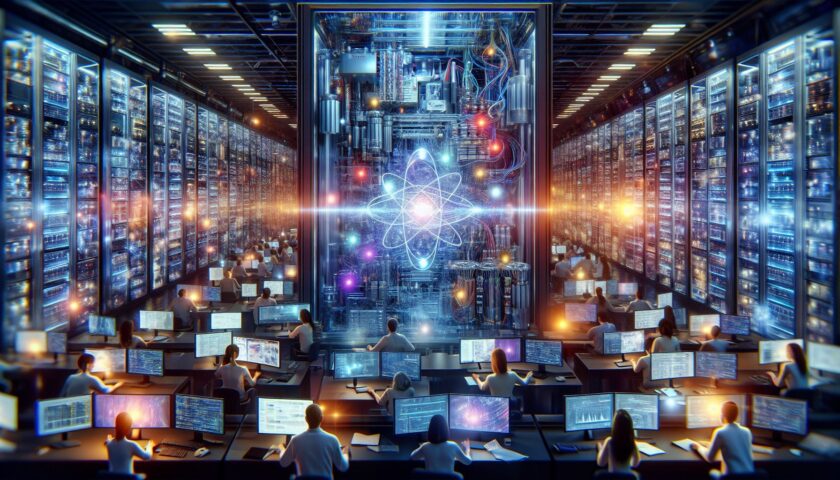
Hey tech enthusiasts! Grab your virtual reality headsets and settle in for a wild ride into the world of quantum computing. If you thought the quantum realm was only for Marvel’s Ant-Man, think again. We’re on the brink of a digital revolution that makes even the most advanced supercomputers feel like abacuses. Let’s dive into what makes quantum computing the next big thing, why you should care, and what sort of quantum shenanigans we can expect in the future.
Quantum What Now?
First off, let me break it down: Quantum computing isn’t just about hanging out with Schrödinger’s cat in a superposition. At its core, it uses the principles of quantum mechanics to process information in ways that classical computers simply can’t. While classical computers use bits (think zeros and ones), quantum computers use qubits, which can exist in multiple states at once, thanks to superposition. This ability opens the doors to mind-blowing computational speeds and processing power.
I know, it sounds like something out of a sci-fi novel, but trust me—quantum computers are very real and getting more practical by the day.
Breaking Down the Breakthroughs
From Fringes to Frontlines
Quantum computing was once the domain of theorists and physicists who occasionally wore wizard hats while scribbling on blackboards. But times are changing. Companies like Google, IBM, and startups you’ve probably never heard of are making real progress. Google’s announcement of “quantum supremacy” in 2019 was a loud and proud statement that the race was heating up. It’s not just them, though. Did you hear about IBM’s legal-sized quantum computers? They’ve gone from lab weirdos to legitimate tech celebrities.
Real-World Applications
OK, enough tech jargon—what does this mean for us normal folks living outside the circuits? Well, quantum computing could revolutionize a bunch of different fields. For example, imagine a world where drug development doesn’t take a decade but happens at a dizzying pace thanks to simulations that are faster than George R. R. Martin’s typing speed.
Or consider traffic optimization, where city symphonies of honking horns become orchestrated streams of efficient flow, all thanks to quantum magic. I’ll bet Elon Musk would love quantum assistance for faster Mars missions too!
Current Challenges: It Ain’t Easy Being Quantum
Cryogenics, Qubits, and Other Headaches
Before you plan your quantum-powered utopia, let me keep it real: quantum computing has some serious hurdles. Qubits are fragile beauties; they need to be kept at temperatures colder than Siberian winters (think fractions of a degree above absolute zero). Maintaining coherence (fancy talk for keeping qubits stable) is a massive challenge that requires some serious ingenuity and not to mention cash.
Plus, if you think debugging traditional code is hard, you’d better buckle in for quantum errors. They’re an entirely different beast.
Peering into the Quantum Future
What Could Be?
Fasten your seatbelts, hypothetical warriors, because we’re diving into speculative waters. Future possibilities are exciting as heck. Cryptography as we know it could be turned on its head. Quantum computers might crack today’s encryption like a kid smashing a piñata. So stay tuned for new ways of securing our data.
Quantum AI? Yeah, it’s exactly as mind-blowing as it sounds. Imagine AI algorithms running like Usain Bolt but researching and solving problems faster than ever before. Scared or excited? Well, a bit of both is an appropriate reaction.
Everyone’s Invited (Eventually)
In the spirit of techno-utopian dreams, I like to think that someday quantum computing will become accessible to regular people, even to my grandma and her unruly cat. Just as personal computers took about 40 years to migrate from intimidating laboratories to our coffee-stained desks, quantum computers might eventually sit in our future workspace with cute quantum keyboards and all. Who knows, maybe you’ll have a quantum AI assistant helping assemble IKEA furniture in real time (because let’s face it, quantum computing should at least solve that chaos).
Conclusion: Just the Beginning
Whether you’re knee-deep in qubit design or just observing from the cosmic sidelines, quantum computing is a paradigm shift that could redefine everything we know about technology, science, and, quite possibly, life as we know it.
I hope this whirlwind tour excited your synapses and tickled your curiosity. We’ve got some wild quantum days ahead, and while the future isn’t certain, one thing is for sure: We’re living in truly fascinating times. Who needed flying cars when quantum circuits are flying us into the next dimension of possibilities? Stay curious, my friends. Our future is unwritten, and you just might be the next trailblazer in this grand quantum adventure.
And that, dear readers, was your daily dose of tech optimism. Now, get back to your regularly scheduled coding or browsing. The quantum age is coming whether we’re ready or not!