The Pace of Orders and What It Means
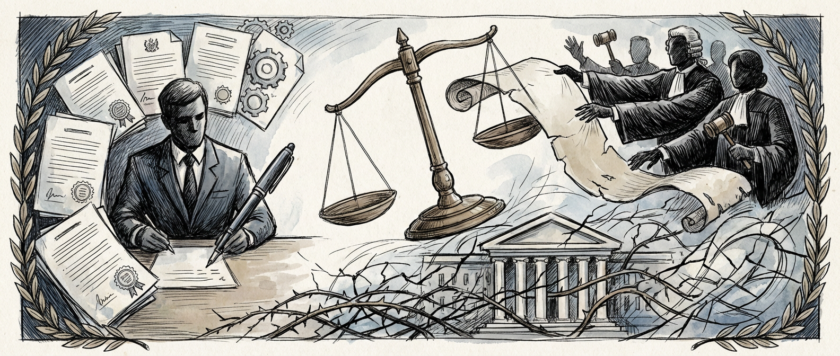
When President Trump returned to the White House on January 20, 2025, his team came prepared with stacks of executive orders ready for signature. By the end of April, the administration had signed more than 100 of them. That is not hyperbole or political spin from either side of the aisle. That is the straightforward timeline of what happened, and it matters because it represents the fastest pace of executive action in the opening months of any modern presidency.

To put this in perspective, Barack Obama signed 55 executive orders in his first 100 days. George W. Bush signed 62. Even Ronald Reagan, often remembered for decisive executive action, signed fewer orders in his first 100 days than Trump did in 2025. The volume alone tells us something: this administration came in with a clear conviction that executive authority was the fastest path to implementing its agenda, whether Congress agreed or not.
But here is where the real story begins. Volume and velocity are one thing. What matters more is what happened next, and who had something to say about it.

The Courts Step In: 30-Plus Injunctions in Six Months
Federal judges did not sit quietly by. According to tracking by the Institute for Constitutional Advocacy and Protection at Georgetown Law, federal courts issued more than 30 injunctions against Trump administration executive actions within the first six months of 2025. These came from judges with both Democratic and Republican-appointed backgrounds, across multiple district courts and appellate panels, stopping or delaying implementation of various orders while lawsuits proceeded.
Thirty-plus injunctions is not a trivial number. It signals that courts across the country were finding serious legal problems with how these orders were being implemented or what authority they claimed. Some challenged the orders on constitutional grounds. Others contested whether the administration had followed proper procedures, considered evidence thoroughly, or acted within the bounds of existing law.
This judicial pushback was not uniform. Some injunctions were temporary, meant to preserve the status quo while a case proceeded. Others were broader and more sustained. Some judges sided with the administration completely. The point is that the courts were actively engaged in reviewing executive action at a level that specialists in constitutional law found noteworthy.
The Chevron Ruling Changed the Playing Field
To understand why these challenges succeeded at the rate they did, you need to know about a Supreme Court decision from 2024 that most people missed: Loper Enterprises v. Raimondo. In that ruling, the Court overturned something called the Chevron doctrine, which had been the legal framework for how courts reviewed regulatory decisions by federal agencies for forty years.
Under Chevron, when an agency interpreted a law and then issued rules based on that interpretation, courts would defer to the agency’s expertise as long as the interpretation was reasonable. The agency had room to work. Now, with Chevron overturned, courts review agency decisions much more skeptically. They no longer assume the agency is right. They look directly at what the law says and ask: did the agency act within its legal authority, or did it exceed it?
For lawyers challenging Trump’s executive orders, this was a game-changer. When agencies tried to implement orders through regulatory guidance or departmental instructions, challengers had a cleaner legal pathway to argue that the agencies were overreaching. At least four major challengers’ organizations specifically cited the Loper decision in their briefs against administration policies in 2025. Federal judges, in multiple cases, agreed that the old Chevron deference no longer applied.
Where the Challenges Concentrated and Won Most Often
The Congressional Research Service, which does nonpartisan analysis for Congress, examined where executive order challenges were most successful in 2025 and found something striking: immigration and federal workforce restructuring orders faced the highest rate of successful judicial challenges since the Nixon era. Two specific areas where Trump had moved decisively through executive action.
On immigration, federal courts blocked or temporarily enjoined multiple executive orders related to asylum policies, refugee processing, and enforcement priorities. On federal workforce issues, courts halted or delayed implementation of restructuring initiatives that the administration pursued through executive authority. These were not fringe victories for challengers. These were consistent, recurring legal losses for the administration in court.
The CRS report did not characterize this as good or bad. Its job is analysis, not judgment. But the data was clear: when the administration tried to implement major policy shifts through executive orders rather than through Congressional action, courts found problems at higher rates than in recent presidential history. When the administration invoked emergency powers, that rate was even higher.
Emergency Powers at Historically Elevated Levels
Speaking of emergency declarations: the Cato Institute, a libertarian think tank that scrutinizes executive power from an ideologically skeptical angle, released its 2025 Executive Power Index. The finding was that the Trump administration’s use of emergency declarations under the National Emergencies Act reached historically elevated levels in 2025. The administration invoked the act at least four separate times in its first year, compared to previous administrations that typically used it once or twice per term.
Emergency declarations matter because they unlock expansive presidential powers. When a president declares a national emergency, agencies can operate with fewer restrictions, move faster, and reallocate funds with less oversight. That is by design in some cases. The statute exists for genuine crises. But when the threshold for invoking it drops significantly, courts and legal scholars tend to ask harder questions about whether the emergency was real or whether it was being used as a shortcut around normal constitutional processes.
Multiple challengers to these emergency declarations cited the Cato analysis in their briefings to federal judges. The volume of emergency declarations, combined with the courts’ new skepticism under Loper, created conditions where judicial review of emergency powers became more intense than it had been in decades.
What This Pattern Tells Us About Executive Power Today
Look at all of this together and a coherent picture emerges. The Trump administration of 2025 came in convinced that executive action was the most efficient tool for policy implementation. It moved fast and broadly. But it did so into a legal landscape that had shifted. Courts no longer deferred automatically to agency interpretations. A major Supreme Court decision had changed the default rule. Legal advocates on multiple sides were mobilized and prepared to challenge orders through litigation.
The result was not a presidency hamstrung by courts. It was a presidency that had to litigate its way forward. Some orders stood. Some were blocked. Some were modified through the process of judicial review. This is separation of powers in practice. It is not dramatic. It is not always satisfying to people who want clear, decisive wins. But it is what the Constitution designed: no branch of government gets to act alone. Power is shared, contested, and tested in court.
If you want to understand what happened in 2025, the data resources are there for you to examine. The American Constitution Society Executive Order Tracker maintains a detailed record of orders and their legal challenges. The Congressional Research Service Reports on Executive Orders provides nonpartisan analysis of trends and outcomes. Read them. Look at the actual numbers. Form your own conclusions about whether these courts were right or wrong to block these orders. That is the point of democratic accountability.
What matters is that you know the facts. You know what actually happened. You know the legal framework that shaped outcomes. Then you can think clearly about what you believe should happen next, grounded in evidence rather than rhetoric.