When Citizens Actually Had to Know Their Candidates
Picture this: you’re standing in the Roman Forum around 63 BCE, and Marcus Tullius Cicero is running for consul. There’s no CNN, no Twitter, no campaign websites. If you want to know where Cicero stands on grain distribution or public works projects, you have to show up when he speaks, ask your neighbors, or rely on the political graffiti scrawled on Pompeii’s walls. Roman voters developed sophisticated networks of information sharing because they understood something we’ve forgotten: knowing your candidates personally wasn’t a luxury, it was a civic necessity.
Fast forward to today, and we’re drowning in information yet starving for real knowledge about the people who’ll decide whether our streets get repaired or our libraries stay open. We can instantly access a congressional candidate’s voting record from 15 years ago, but somehow we’re clueless about who’s running for school board. The irony hits hard. Local elections, where your vote carries way more weight than in any federal race, often see turnout rates that would make ancient Roman patricians weep for their “good old days” of civic engagement.
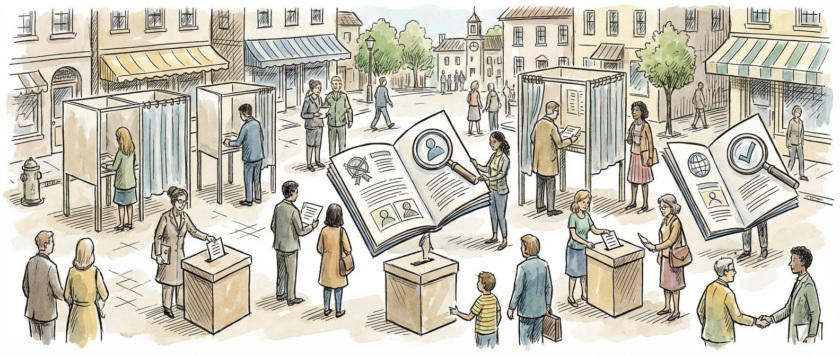
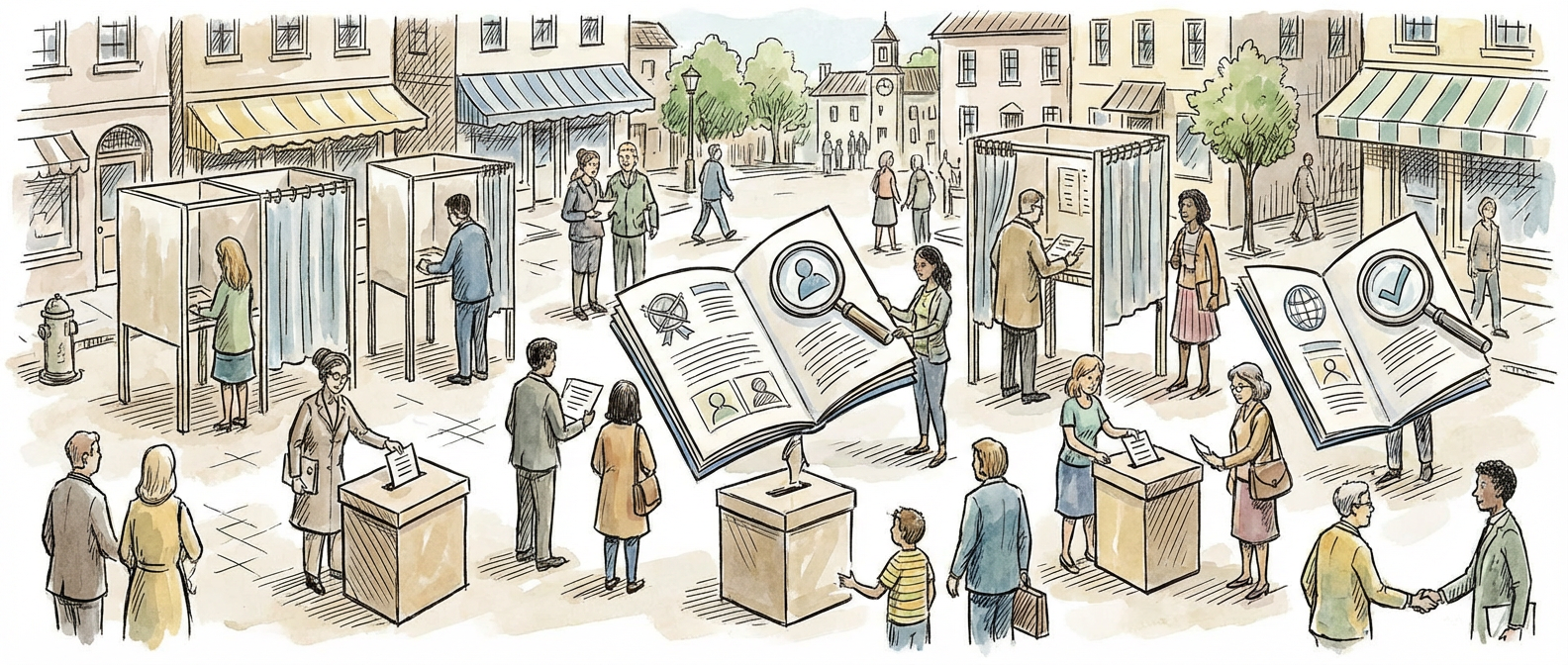
This is where the humble voter guide enters our story. It does the same essential job that Roman clientela networks once did: connects citizens with the information they need to choose leaders wisely. But unlike those ancient systems built on personal relationships and social hierarchies, modern voter guides offer us something different: they democratize candidate research.

The Information Revolution That Wasn’t
The printing press gave us pamphlets. Radio brought us candidate speeches in our living rooms. Television let us see politicians sweat during debates. The internet promised to complete this arc, delivering perfect information to every voter’s fingertips. Yet somehow, local election turnout keeps dropping, and many citizens remain genuinely mystified about what their city council actually does.
Here’s what the Romans understood that we’re still learning: information without context is just noise. Those ancient voters didn’t need to know every detail about every candidate because they understood their political system inside and out. They knew which magistrates controlled the grain supply, who oversaw public games, and how the cursus honorum (the ladder of political offices) actually worked. We have access to infinitely more raw data, but we often lack this basic civic literacy.
This knowledge gap creates a weird paradox. We live in the most transparent political era in human history, yet many voters feel more disconnected from their local government than citizens of ancient city-states who had to physically gather in public spaces to hear candidates speak. The difference isn’t access to information, but our ability to process and contextualize it meaningfully.
Good voter guides bridge this gap by doing something our information-saturated age desperately needs: they curate and contextualize. They tell you not just what candidates believe, but what those beliefs mean for your daily life. When a school board candidate talks about “fiscal responsibility,” a good voter guide explains whether they mean cutting art programs or renegotiating bus contracts.
Democracy’s Local Laboratory
The New England town meeting, that uniquely American contribution to democratic governance, offers perhaps the closest modern parallel to ancient Athenian democracy. In both systems, citizens gathered regularly to debate and decide community issues face-to-face. These weren’t representative democracies where voters selected others to govern for them. They were direct democracies where every citizen was expected to participate actively in governance.
What made these systems work wasn’t just the direct participation, but the fact that participants came prepared. Athenian citizens spent considerable time discussing upcoming issues in the agora before formal debates. New Englanders arrived at town meetings having already hashed out road repairs and school budgets with their neighbors. Information sharing was woven into the social fabric of civic life.
Local elections today try to recreate this informed participation, but without the natural information networks that made historical direct democracy possible. We’ve kept the democratic structure while losing the social infrastructure that supported it. This is exactly where thoughtful voter guides become essential democratic tools, replacing the informal knowledge networks that once thrived in smaller, more connected communities.
Think about how this plays out in practice. Your great-great-grandmother might have known the local school board candidates personally, understood their family backgrounds, and seen their judgment in countless community situations. You, by contrast, might encounter their names for the first time when you’re standing in the voting booth. A good voter guide doesn’t just level this playing field, it actually creates opportunities for more informed decision-making than personal acquaintance alone could provide.
The Mechanics of Modern Civic Education
The League of Women Voters understood this challenge when they began producing voter guides in the early 20th century. Their innovation wasn’t technological, it was methodological. They created a standardized format for presenting candidate information that put clarity and fairness first, not entertainment or political advantage. This approach borrowed from the best traditions of civic education while adapting to the realities of modern electoral complexity.
The most effective voter guides today build on this foundation while embracing new possibilities for civic engagement. They don’t just list candidate positions, they explain the actual powers and responsibilities of each office. They provide budget context when candidates discuss spending priorities. They translate policy jargon into plain English and help voters understand how seemingly abstract issues like zoning laws or bond measures will affect their daily lives.
The best guides also embrace something the Romans would recognize: the importance of character assessment. Ancient Roman voters paid careful attention to candidates’ virtus (virtue) and dignitas (worthiness), understanding that technical qualifications meant little without personal integrity. Modern voter guides achieve this through careful questioning about candidates’ backgrounds, decision-making processes, and responses to challenging scenarios.
What’s genuinely exciting about this moment in democratic history is how digital tools are making high-quality voter guides more accessible and interactive than ever before. Candidates can provide detailed responses to policy questions, link to supporting documents, and engage in ongoing dialogue with voters throughout the campaign season. Citizens can access this information whenever and wherever it’s convenient for them, removing many traditional barriers to informed participation.
Building Tomorrow’s Civic Infrastructure
The historical parallel isn’t perfect, of course. Roman elections were limited to a narrow slice of society, and even Athenian democracy excluded women, slaves, and foreigners. Our challenge is more complex: creating an informed electorate that includes everyone, not just those with the time, education, or social connections to navigate complex political systems naturally.
This is where the future of voter guides becomes genuinely exciting. We’re not just trying to recreate the informed participation of historical democracies, we’re trying to extend it to every citizen in an incredibly diverse, complex society. Digital voter guides can be translated into multiple languages, made accessible to people with disabilities, and tailored to different levels of civic knowledge without losing accuracy or depth.
The opportunity ahead of us is unprecedented in human history: the chance to create truly universal civic literacy. When every voter has access to comprehensive, unbiased information about every candidate and issue on their ballot, we move closer to the democratic ideal than any previous generation has achieved.
What will you do with this opportunity? The next time your local election approaches, seek out those voter guides. Read them carefully. Share them with your neighbors. And if you can’t find one that meets your community’s needs, consider the possibility that democracy is calling you to create one yourself.