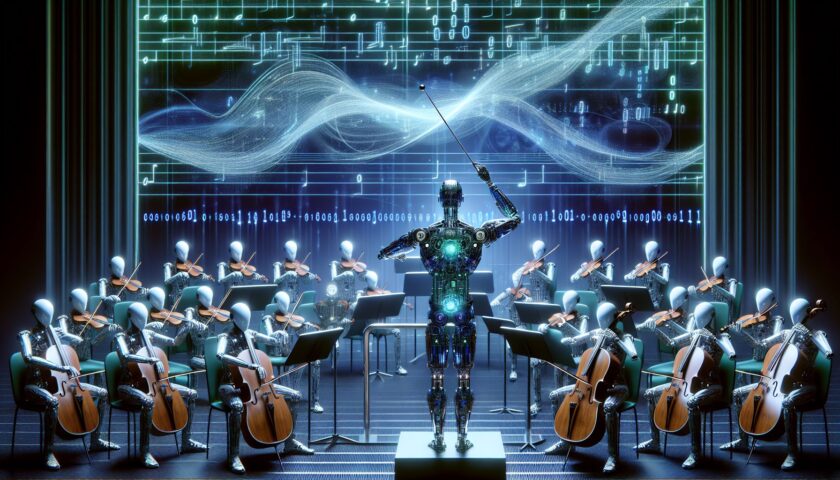
Hey tech enthusiasts! Gather ’round because today’s blog post is all about a fascinating crossroads between the high-tech and the heart-touching—the wild fusion of Artificial Intelligence and the world of creative arts. If you’ve ever wondered what happens when silicon meets sentiment, you’re in for a treat. We’ll explore the latest trends in AI artistry, tackle some mind-bending questions about creativity, and look toward what the future might hold for this unusual partnership. So, let’s jump right in, shall we?
From Sci-fi Dreams to Studio Reality
I remember when sci-fi used to be the only place you’d find artificial intelligence belting out a tune or whipping up a masterpiece. Fast forward to today, and it’s not just a wacky idea slapped onto the back of a VHS tape. We’re living in an era where AI can actually generate music, art, and even write literature. It’s as if HAL 9000 decided to stop being kind of a jerk and start unleashing his inner Mozart.
But how did we get here? Well, AI in the creative arts has been evolving steadily over the past few years, thanks to companies like OpenAI and tools such as GPT-3 and DALL-E. These digital maestros take an enormous set of data—think of countless songs, paintings, or novels—and use it to generate entirely new pieces that are absolutely fresh yet eerily familiar. It’s like being serenaded by a robot who’s read your entire Spotify playlist and knows exactly what you like.
AI Companions: Art’s Newest Collaborators
Let’s talk about collaboration—one of the cornerstones of creativity. Traditionally, artists have bounced ideas off each other, or sometimes their cats (seriously, some of history’s greatest works owe a big thank you to a furry muse). Now, add AI to that list of collaborators.
Imagine you’re an aspiring musician, toiling away on your latest track. You’re stuck on a riff that seems as elusive as a decent Wi-Fi connection in the middle of a Zoom call. Enter AI. Tools like Amper Music and AIVA offer musicians virtual jam sessions where AI composes sounds and sequences, providing the spark needed to light that creative fire. It’s like having a musical buddy who doesn’t mind working at 3 AM.
Writers aren’t left out of the party either. With AI-assisted tools, they can generate storylines, resolve plot holes, and even help with character development. That’s right—instead of staring at a blinking cursor for hours, you could have a robot dish out some inspiration like it’s Oprah handing out car keys.
Show Me the Monet: AI-Generated Visual Art
If music and wordsmithing weren’t enough, let’s dive into the visual arts. AI in visual art is straight up mesmerizing, like a Monet that suddenly decided it wanted to also be a Picasso, and maybe even pull a prank or two inspired by Banksy. We’re talking about AI capable of anything from generating trippy abstract paintings to creating realistic human portraits.
One of the coolest things I’ve seen lately is AI-generated art being auctioned at major galleries. Christie’s even sold an AI-produced piece called “Portrait of Edmond de Belamy” for a cool $432,500. Not bad for something birthed from lines of code, right?
These AI creations prompt serious questions about creativity and authorship. Who really owns the art? This question is triggering lively debates even the most sophisticated algorithms can’t yet untangle. Artists have started using AI tools like DeepArt and ArtBreeder to create unique, memorable pieces of art, each with a touch of human-AI collaboration.
The Ethical Kaleidoscope: Questions and Challenges
While the AI-driven creative boom is undeniably exciting, it doesn’t come without its share of challenges and ethical conundrums. Who should be credited for AI-generated art? What happens to copyrights when the line between human and AI creation blurs? And let’s not forget about job security—what does AI mean for aspiring artists?
It’s a slippery slope, my friends. The path of integrating AI into the arts is fraught with questions about originality, ownership, and the value we place on human-made versus AI-made art. Imagine an AI stealing the show at the Grammys or the Oscars. Are we ready for that?
Then there’s the risk of homogenization. If everyone uses similar AI models to generate art, could we end up in a creative monoculture where all artistic expression blends together in a dull uniformity? It’s a puzzle that will undoubtedly require artists, technologists, and ethics scholars to solve, preferably over some really strong coffee.
Peeking into the Crystal Ball: What’s Next?
Predicting the future of AI in the creative arts is as tricky as forecasting the stock market (or playing chess against a grandmaster, for that matter). But it’s clear that this is just the beginning. You can expect AI tools to become more sophisticated and more accessible, allowing even the most technologically-challenged of us to create something magical.
I wouldn’t be surprised if AI starts getting involved in bringing immersive experiences to life. Imagine interacting with an environment that changes the soundtrack and visual art based on your mood, captured by biofeedback sensors. We could very well be on the verge of experiencing art in ways we never thought possible.
Artists will continue to refine their relationships with AI companions, blurring the lines between who—or what—is driving the creative bus. The journey will be full of innovation, surprise, and yes, a fair share of bumps along the way.
Wrapping it Up
In the grand symphony of human ingenuity, AI in the creative arts is a new instrument being added to the orchestra, mixing tech-savvy precision with the messy, beautiful chaos of human creativity. From studio playlists to gallery walls, and science fiction to everyday reality, AI isn’t just a tool—it’s a new kind of artist, one eager to work alongside us.
As we embrace this brave new world, let’s continue to ask questions, push boundaries, and celebrate the surprises that emerge from this exceptional collaboration. And who knows? Maybe someday, artificial and human artists will sit side-by-side at an awards ceremony, each raising a glass to the other’s contributions in a toast to creativity’s wild possibilities.
So here’s to AI, our newest creative partner, and to a future where art knows no bounds. Let’s make it extraordinary.