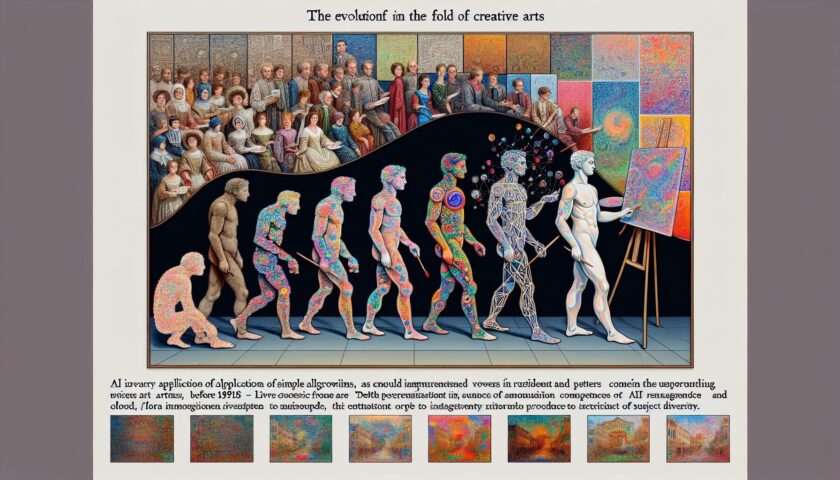
Hey there tech explorers! So, I’ve been diving headfirst into the world of emerging technologies and I can’t help but feel like a kid in a candy store every single day. Today, I’ve got something that’s not just intriguing but straight-up mind-bending for all you creative souls out there. We’re talking about Artificial Intelligence pretty much making its way into every creative nook and cranny. Yep, AI in creative arts is no longer a sci-fi trope. It’s happening, and it’s wilder than you think!
When Algorithms Meet Artistry
Let’s roll back a bit to get a sense of how we got here. Remember when AI was just a bunch of geeky algorithms that helped us sort our photos or spam emails? Well, those days are long gone. AI is now donning a beret and getting its hands paint-splattered in the art studio. Technologies like Generative Adversarial Networks (GANs) have turned AI from being mere digital assistants to full-blown creators. These are the same technologies behind mind-boggling projects like DeepArt and DALL-E.
When OpenAI launched DALL-E, an AI model that creates images from textual descriptions, the internet went into a frenzy. I mean, who wouldn’t get excited about typing in “a fantasy castle made of chocolate” and getting a drool-worthy image of exactly that? AI is pushing past boundaries we didn’t even think existed!
The New Age of Creative Collaboration
One of the coolest things about AI in creative arts is how it’s changing collaboration. Think of it as having a world-class assistant with infinite patience that’s always ready to brainstorm with you. Artists are using AI to expand their unique visions, working alongside these digital brains to bring something to life that neither humans nor machines could achieve alone.
Some creative maestros are even developing “adaptive” art—works that learn and evolve based on the audience’s reactions. Think back to sitting through an art exhibit and wishing one of those silent, solemn paintings would just turn around and say, “Hey, what do you think of this?” Welcome to the future!
Human Element vs. Machine Precision
Now, I can already hear some of you raising an eyebrow and asking, “But doesn’t this take out the human element from art?” Well, here’s where it gets extra thrilling. AI isn’t here to steal the artist’s paintbrush. It’s here to redefine the canvas.
It’s kind of like when Bob Ross taught us that even the happiest of accidents can lead to masterpieces. AI is adding a layer of complexity and depth that often eludes even the best human creators. Personally, I’ve seen AI generate patterns and color schemes in seconds that would take even seasoned designers ages to develop. Yet, it’s the artists who set the tone and call the shots, creating an innovative dance between man and machine.
Challenges? Absolutely!
Of course, let’s not pretend the sky is all rainbows and unicorns. Critics and skeptics argue about issues ranging from IP rights to ethical dilemmas. There’s that ever-present fear of mass-replicated, soulless art taking over. And the concept of “authorship” becomes a real head-scratcher—whose name gets inked on a piece, the algorithm or the artist? This territory is as exciting as it is tricky.
We’re also navigating an entirely new realm of digital forgeries and deepfakes. If a picture is worth a thousand words, an AI-generated video can swap entire dictionaries!
Gazing Into the AI-Powered Crystal Ball
So, where does all this lead us? Honestly, the potential is limitless. We’re already seeing AI model-driven music albums, scriptwriting software developing movie plots, and even computational designers orchestrating entire virtual worlds. The future might see AI becoming as essential to artists and creators as Photoshop or AutoCAD is today. Imagine an AI co-writer for your band, spitting out guitar riffs that are perfect fits every single time.
On the speculative side (call me a dreamer!), we might have AI-driven tech that integrates into VR environments, allowing artists to craft entire immersive experiences as they’re conceptualized, right from their mind to digital space.
Closing Thoughts
With every algorithm and data set, AI in creative arts is proving that the fourth wall of innovation is just a suggestion, not a barrier. In this emerging era, art isn’t just an echo of the human spirit. Now it marries with technology to become something new, something transcendent. How cool is it that we get to witness this fusion unfold in real time?
So, here’s a virtual toast to the imaginative alliance of silicon and soul, the dreamers and coders, and to AI’s artistic leap into the unknown. Let’s keep our eyes peeled, our minds open, and our canvases sprawling. It’s going to be a masterpiece unlike any other!