The AI Governance Divide: How Europe and America Are Building Incompatible Digital Futures

When Two Democracies Choose Different Roads

Let me start with something that might seem obvious but bears repeating: how nations choose to govern artificial intelligence matters profoundly. This isn’t abstract policy debate. The choices being made right now in Brussels and Washington, and increasingly in Beijing, will shape what AI systems billions of people interact with, how those systems make decisions about us, and whether democratic societies retain meaningful oversight of transformative technology. By mid-2025, we arrived at a moment that few predicted would come this clearly and this soon. The EU and the United States have chosen fundamentally incompatible regulatory philosophies, and the consequences are already rippling through the global technology ecosystem in ways we’re only beginning to understand.

Here’s what happened: The EU’s carefully constructed approach to AI governance, debated and refined over years, came into full force in August 2025. The high-risk AI systems provisions of the EU AI Act official text and implementation timeline took effect, establishing clear compliance requirements backed by teeth. The potential penalties are substantial enough to get corporate attention. Companies now face fines reaching up to 35 million euros or 7 percent of global annual turnover, whichever is higher, for violations. Simultaneously, across the Atlantic, the Trump administration issued an executive order in January 2025 that explicitly rescinded Biden-era AI safety directives and told federal agencies to prioritize AI deployment speed over precautionary regulation. These weren’t minor adjustments to different corners of the same policy framework. These were different answers to the fundamental question of how much caution democracies should exercise when deploying powerful new technologies.

The Compliance Contradiction That Nobody Wanted

Here’s where it gets genuinely complicated, and this is where I need to be fair to the companies caught in the middle even as we examine what they’re actually doing. OpenAI, Google DeepMind, and Meta all submitted compliance documentation to the EU AI Office during the third quarter of 2025. They hired compliance teams, conducted impact assessments, modified their systems to meet European standards. That costs real money and real engineering time. But here’s the part that reveals something important about how concentrated power in the tech industry really operates: these same companies were simultaneously lobbying the U.S. Commerce Department to resist adopting equivalent standards. They’re not just operating in two different jurisdictions with different rules, which would be manageable. They’re actively working to ensure the rules stay different and incompatible.

The practical result is almost absurd when you think about it clearly. An AI system deployed in Europe has to meet robust transparency requirements, human oversight provisions, and documented risk assessments for high-risk applications. That same company’s system deployed in the United States operates under a fundamentally lighter-touch framework that emphasizes innovation velocity. The same underlying technology. Different governance. Different levels of accountability. Different assumptions about what risks societies should tolerate. A researcher at Stanford’s Human-Centered Artificial Intelligence program published analysis in October 2025 showing that regulatory divergence between EU and U.S. frameworks is creating compliance costs estimated at 4.2 billion dollars annually for multinational AI developers. Think about what that figure actually means. That’s not just the cost of building two versions of governance infrastructure. That’s 4.2 billion dollars annually that could theoretically go toward actually building better AI systems, training researchers, or supporting communities dealing with technological disruption. Instead, it’s absorbed by the friction created when democracies can’t agree on basic governance principles.

When Three Powers Make None Compatible

But the situation becomes more complex still, and more important to understand clearly. Europe’s regulatory framework and America’s light-touch approach aren’t the only two models in play anymore. China’s Cyberspace Administration finalized its second round of generative AI regulations in mid-2025, creating what the OECD has described as “the most consequential splintering of technology governance norms since GDPR.” Three major powers. Three incompatible regulatory philosophies. China’s framework prioritizes state oversight and content control. The EU prioritizes democratic accountability and individual rights. The United States prioritizes market innovation and competitive deployment. None of these approaches is obviously wrong in the abstract. Each reflects genuine values that reasonable people hold. The problem is that they’re incompatible in practice.

This three-way fragmentation matters because it reshapes how technology itself evolves. Companies building AI systems now don’t just need to ask what’s possible or what’s best. They need to ask what’s legal in Beijing, what’s legal in Brussels, and what’s legal in Washington. When those three jurisdictions want fundamentally different things, you get technological development optimized for regulatory arbitrage rather than for actual human benefit. You get companies making decisions about whose data gets processed more carefully, whose privacy gets protected more robustly, based on where they’re legally required to do so rather than based on ethical reasoning about what actually serves people. The Stanford HAI AI Index and policy briefs documents this emerging pattern in detail. Worth reading if you want concrete data on how governance fragmentation affects actual technology development.

What This Reveals About Democratic Governance and Power

Let me offer a dissenting view here, because I think we need to be honest about multiple competing truths simultaneously. The EU’s approach is more democratically robust. It builds in oversight, requires transparency, creates mechanisms for meaningful human review of high-stakes AI decisions. That’s genuinely valuable. A democratic society should probably want that. But I also understand the concern embedded in the American approach. Regulatory barriers really do slow innovation. They do create compliance burdens that smaller companies can’t absorb the way giants like OpenAI and Google can. If you believe that AI capabilities development needs to accelerate to solve other critical problems, if you think the precautionary principle can calcify societies into inaction, then the lighter regulatory approach has real merit. China’s framework prioritizes stability and unified societal direction in ways that some would argue enables faster deployment and clearer national strategy, even if we in democracies find the governance mechanisms unacceptable.

The honest assessment is that each approach trades off different values. The EU approach trades innovation speed for democratic accountability. The American approach trades oversight for competitive deployment. The Chinese approach trades individual liberty for strategic coordination. None of these is irrational on its face. But the divergence between them creates a situation where companies can dodge whichever standard is most inconvenient by shifting operations or arguments or technical implementations based on geography. That’s not governance. That’s governance theater performed for three different audiences that can’t see each other’s stage.

Where Power Concentrates When Rules Diverge

Here’s what concerns me most about this fragmentation, and I want to be direct about it. When regulatory standards diverge radically, power concentrates in the hands of whoever can afford to navigate all three systems simultaneously. The multinational tech giants can hire the compliance teams, maintain the infrastructure, lobby all three regulatory spheres. Smaller companies, academic researchers, non-profit technologists, public-interest organizations get squeezed. They either have to pick a market to serve, which limits their reach, or they have to absorb the complexity and cost that currently adds 4.2 billion dollars annually to the sector. That’s a systematic advantage handed to already-dominant players. In a moment when we should probably be asking how to prevent AI technology from concentrating power in fewer and fewer hands, our regulatory divergence is actively pushing toward that outcome.

The practical implication for people who care about democratic governance should be clear. If you believe that technology should remain democratically accountable, that communities should have meaningful say in how powerful systems operate within their borders, then regulatory fragmentation is actually the enemy of that goal even when some of those fragmented regulations look more protective individually. Fragmentation lets powerful actors play regulators off against each other, shape policy through lobbying rather than public deliberation, and make the whole system so complex that ordinary people and institutions can’t meaningfully participate in governing the technology anymore.

What Comes Next and What We Might Actually Do

The EU and U.S. regulatory divergence isn’t a temporary problem that might resolve itself. The structural incentives all push in the direction of continued fragmentation. Each jurisdiction has genuine reasons to prefer its own approach. Convergence would require compromise, and compromise in this domain means somebody’s core values don’t get reflected in the rules. That’s hard. But the alternative is a world where AI governance becomes a kind of regulatory arbitrage game played by the most powerful corporations while democratic publics lose meaningful input into the systems that shape our lives.

What would actually change this trajectory? Probably not top-down negotiation
The AI Governance Divide: How the EU’s Bold Regulatory Move Is Fracturing Global Tech Standards

When Regulatory Visions Collide: Understanding the January 2025 Inflection Point

We are living through a moment that will almost certainly be taught in civics classes decades from now, though probably not in the way we expect. The divergence between American and European approaches to artificial intelligence governance isn’t just a trade dispute or a regulatory disagreement. It’s something more fundamental: a fracturing of the assumptions that underpinned the post-Cold War international order around technology standards.

Consider what happened in the span of a few weeks in early 2025. The Trump administration issued an executive order in January that explicitly rescinded Biden-era AI safety directives and instructed federal agencies to prioritize deployment speed over precautionary regulation. Meanwhile, across the Atlantic, the European Union was implementing the final enforcement mechanisms of its AI Act, which had come into full force in August 2024 for high-risk systems. The fines for non-compliance were real and substantial: up to 35 million euros or 7% of global annual turnover, whichever number proved higher. That’s not theoretical deterrence. That’s the kind of number that changes boardroom conversations.

The timing wasn’t accidental. It was the logical conclusion of two different political philosophies finally reaching the point where compromise became functionally impossible. The EU had spent years building a regulatory framework grounded in the precautionary principle. The United States, newly committed to a different administration, had spent those same years concluding that precaution was the enemy of progress.

The Compliance Shuffle: When Tech Giants Play Two Sides

If you want to understand how real this divide has become, follow the paper trail. In the third quarter of 2025, OpenAI, Google DeepMind, and Meta all submitted formal compliance documentation to the EU AI Office. These weren’t generic letters of assurance. They were detailed, expensive, professionally-crafted submissions documenting how their systems met European standards for transparency, human oversight, and risk management. The same companies, operating from the same headquarters, were simultaneously lobbying the U.S. Commerce Department to resist adopting anything resembling equivalent standards.

This isn’t hypocrisy, exactly. It’s something more interesting and more troubling: it’s the rational response of multinational corporations to regulatory fragmentation. When the rules are different in different places, companies build different systems for different markets. That’s what they did with privacy after GDPR. But AI is different. You can’t easily build two different AI systems. You can’t have a “European version” and an “American version” of your large language model the way you might have different privacy settings in different browser versions. The compliance costs are brutal and they’re structural.

A Stanford HAI policy brief from October 2025 quantified this pain. The researchers estimated that regulatory divergence between the EU and U.S. frameworks was creating annual compliance costs of approximately 4.2 billion dollars for multinational AI developers. That’s not money spent on innovation or safety improvements. That’s money spent on navigating two different sets of rules, maintaining dual documentation systems, and managing legal risk across incompatible jurisdictions. For context, that number is larger than the entire venture capital funding that went to safety-focused AI startups in 2024.

Three-Way Fragmentation: When the Problem Gets More Complicated

But here’s where the story gets more complex. While the EU and the U.S. were moving in opposite directions, China wasn’t standing still. The Cyberspace Administration finalized its second round of generative AI regulations in mid-2025, creating a third regulatory framework that operated according to its own logic and priorities. The OECD, observing these three power centers developing three distinct approaches to the same technology, issued a stark assessment: this represented the most consequential splintering of technology governance norms since GDPR fundamentally reshaped how the world thought about data.

That OECD characterization matters because it’s not just technical analysis. It’s a warning. GDPR forced the world to reckon with a new standard. Corporations grumbled. American tech companies adapted. Over time, many jurisdictions adopted GDPR-like frameworks because the EU’s scale and economic power made compliance inevitable, and because some level of harmonization is less painful than perpetual fragmentation. But that process took years and created real friction. We’re now looking at the possibility of doing that same dance three times simultaneously, with AI, and with stakes that might be even higher.

Here’s a historical parallel worth sitting with. In the 1920s and 1930s, as radio technology developed, different countries adopted different standards. The technical advantages were often minimal. The real reasons were political and economic. This fragmentation created genuine inefficiency and slowed global adoption of radio technology. Eventually, through a combination of necessity and negotiation, some level of harmonization emerged. But the period of fragmentation was costly and chaotic. We’re not doomed to repeat that history with AI, but the structural incentives pushing us toward fragmentation are real and powerful.

The Real Stakes: Democracy, Innovation, and Who Gets to Choose

You might be asking: isn’t this just how global capitalism works? Don’t different countries always have different rules? That’s true. But what makes this moment different is that we’re not talking about tariffs or labor standards or environmental regulations. We’re talking about who gets to shape the fundamental capabilities and constraints of a technology that will define the next era of human civilization. The regulatory choices made in 2025 and 2026 aren’t just about compliance costs for tech companies. They’re about encoding different values and different visions of how AI should relate to society into the actual architecture and deployment of these systems.

The EU’s approach, embodied in EU AI Act official text and implementation timeline, is grounded in a theory of innovation that assumes constraints can be productive. The thinking goes: if you have to build in transparency, if you have to maintain human oversight, if you have to assess risks systematically, you might deploy more slowly, but you’ll deploy more wisely. The American approach, at least as currently constituted, is grounded in a different theory: that regulatory constraints are primarily brake pedals, and that the brake pedal is being pressed too hard.

Neither approach is self-evidently correct. Both have merit. Both have serious problems. The EU’s approach might slow beneficial innovation. The U.S. approach might normalize risks that we should collectively be more cautious about. But here’s what’s crucial: this isn’t a theoretical debate anymore. These are operational realities that developers and policymakers are navigating right now.

What Comes Next: Research, Advocacy, and Staying Informed

If you’re following this issue and trying to understand where the real power lies in shaping AI governance, start by reading the original policy documents rather than summaries of them. The Stanford HAI AI Index and policy briefs do excellent work translating technical regulation into understandable policy analysis. Look at who’s lobbying your representatives about AI standards. Connect with civil society organizations in your jurisdiction that are engaging with this question. These frameworks are being built now, and while most of us aren’t tech policy specialists, the choices being made will affect all of us.

The reason I bring this up is that democratic input into technological governance usually only happens after technologies are already deeply embedded. We have a genuine opportunity right now to ask different questions and to push back against the assumption that these regulatory choices are purely technical matters for experts and corporations. What values do you think should be embedded in AI systems? What risks matter most to you? How do you think democratic societies should balance innovation speed against other priorities? These aren’t abstract questions. They’re the questions that regulatory frameworks like the EU AI Act are actually trying to answer. They deserve your attention.

Trump’s 2025 Tariff Order: What the Data Shows About the New Global Trade Framework

The April 2025 Executive Order: What Actually Happened

On April 2, 2025, President Trump signed an executive order that fundamentally restructured how the United States calculates tariffs on imports. Instead of the negotiated rate schedules that had governed most trade relationships since the Uruguay Round, the new framework established a baseline 10 percent tariff on virtually all incoming goods. But here’s where the architecture gets interesting: the order didn’t apply a flat rate across the board. It created a “reciprocal” system where countries deemed to maintain unfair trade barriers faced significantly higher rates. China ended up in the highest tier, facing an additional 34 percent tariff stacked on top of existing levies.

This wasn’t a modest adjustment to trade policy. This was a categorical shift in the assumptions underlying American trade law. For decades, the U.S. negotiated bilateral and multilateral agreements that tried to lock in specific tariff rates. The new model inverted that logic. It started with a floor and then raised rates based on what administration officials characterized as a country’s trade practices. The order claimed to calibrate rates based on market access, intellectual property protections, and currency management. Whether those characterizations withstand scrutiny is exactly the kind of question that separates good policy analysis from partisan cheerleading.

Historical Context: Where This Ranks

The Peterson Institute for International Economics, a research organization that’s been tracking trade policy since the 1980s, ran the numbers on what this tariff package meant in historical terms. Their analysis showed that when you calculated the average effective tariff rate across all American imports under the new framework, it reached levels not seen since the 1930s Smoot-Hawley era. That’s not hyperbole. That’s what the data showed. The Smoot-Hawley comparison matters because economists and historians have spent ninety years debating whether that tariff regime accelerated the Great Depression or merely accompanied it. The point isn’t that history repeats itself. The point is that we’re talking about tariff levels that require serious historical comparison.

Understanding this context helps explain why the market reaction was so swift. Traders and investors weren’t responding to ideology. They were responding to a measurable change in the cost structure of American imports. When you increase the average tariff rate to 1930s levels, you’re not fine-tuning trade policy. You’re making a fundamental statement about how you want the American economy to function. For those interested in the technical details and the specific tariff schedules involved, the Office of the United States Trade Representative: Reciprocal Tariffs page walks through the framework with the precision you’d expect from agency documentation.

The Retaliation Sequence and What It Reveals

China responded within 72 hours with counter-tariffs of its own, imposing 34 percent tariffs on American goods in direct response. This wasn’t a measured escalation. This was tit-for-tat retaliation at scale. Within two trading sessions following the Chinese announcement, the S&P 500 dropped approximately 10 percent. That’s the kind of market movement that gets everyone’s attention, and it suggests institutional investors saw the reciprocal tariff order not as a negotiating opener but as a genuine disruption to existing supply chains and profit margins.

The European Union took a different approach. Rather than immediate counter-tariffs, the EU invoked its new Anti-Coercion Instrument for the first time. This was a legal framework the EU had built specifically to handle situations where a powerful trading partner tried to impose policy preferences through tariff threats. The EU authorized retaliatory measures on approximately 26 billion euros in American exports. The dollar figure matters, but what matters more is that the EU treated the American tariff order as sufficiently threatening that it activated legal tools designed precisely for this kind of confrontation. That’s a significant institutional shift, and one I don’t think got nearly enough coverage at the time.

The 90-Day Pause and the Ongoing Standoff

To reduce immediate market volatility and create space for negotiation, the administration announced a temporary 90-day pause on tariff implementation for most countries. Most, that is, except China. China remained subject to the full reciprocal tariff regime even during the pause period. This distinction revealed which country the administration viewed as the central target of the new tariff architecture. The pause gave other trading partners time to negotiate bilateral deals or make policy changes that would lower their effective rates, but it left the fundamental U.S.-China trade conflict completely unresolved.

Fast forward to early 2026. According to USTR reporting, a comprehensive bilateral deal between Washington and Beijing remains unresolved. This isn’t really a failure of negotiating skill on either side. It reflects how deeply the two countries’ economic and strategic interests diverge. China is not going to agree to terms that fundamentally restructure its industrial policy. The United States is not going to reduce tariffs without seeing meaningful changes in Chinese trade practices. The 90-day pause did what it was designed to do: it bought time. But it didn’t resolve anything. For a detailed breakdown of how these tariff rates compare to historical precedents, the Peterson Institute for International Economics: Tariff Impact Analysis offers granular comparisons across multiple time periods.

What This Means for How We Understand Trade Policy Now

The reciprocal tariff framework represents a genuine philosophical break with how the United States approached trade for the previous four decades. That doesn’t mean it’s right or wrong. It means it’s different. Previous administrations, whether Democratic or Republican, generally assumed that lower tariffs and integrated global supply chains served American interests. The reciprocal tariff approach assumes that negotiated, sector-specific rates calibrated to protect particular American industries serve American interests better. These are testable propositions. Over the next several years, we’ll have actual data on how this framework affects employment, consumer prices, investment, and productivity. That data will matter more than any argument anyone makes right now.

What we can say with certainty is that the global trading system is being redrawn. Other countries are no longer waiting passively for American trade policy to settle. They’re building coalitions, invoking legal instruments they’d previously held in reserve, and developing alternative supply chains that don’t depend on American markets. These responses aren’t theoretical. They’re happening now. If you want to understand where American trade policy is heading, the best starting point is always the actual numbers: what tariffs are, which countries face them, and what economic effects we’re actually observing. What patterns are you seeing in your own community or sector? Share what you’re tracking.

Executive Orders and the Courts: What Trump’s First Year Tells Us About Presidential Power in 2025

Executive Orders and the Courts: What Trump’s First Year Tells Us About Presidential Power in 2025

The Pace of Orders and What It Means

When President Trump returned to the White House on January 20, 2025, his team came prepared with stacks of executive orders ready for signature. By the end of April, the administration had signed more than 100 of them. That is not hyperbole or political spin from either side of the aisle. That is the straightforward timeline of what happened, and it matters because it represents the fastest pace of executive action in the opening months of any modern presidency.

Executive Orders and the Courts: What Trump's First Year Tells Us About Presidential Power in 2025
Executive Orders and the Courts: What Trump’s First Year Tells Us About Presidential Power in 2025

To put this in perspective, Barack Obama signed 55 executive orders in his first 100 days. George W. Bush signed 62. Even Ronald Reagan, often remembered for decisive executive action, signed fewer orders in his first 100 days than Trump did in 2025. The volume alone tells us something: this administration came in with a clear conviction that executive authority was the fastest path to implementing its agenda, whether Congress agreed or not.

But here is where the real story begins. Volume and velocity are one thing. What matters more is what happened next, and who had something to say about it.

Illustration for Executive Orders and the Courts: What Trump's First Year Tells Us About Presidential Power in 2025
Illustration for Executive Orders and the Courts: What Trump’s First Year Tells Us About Presidential Power in 2025

The Courts Step In: 30-Plus Injunctions in Six Months

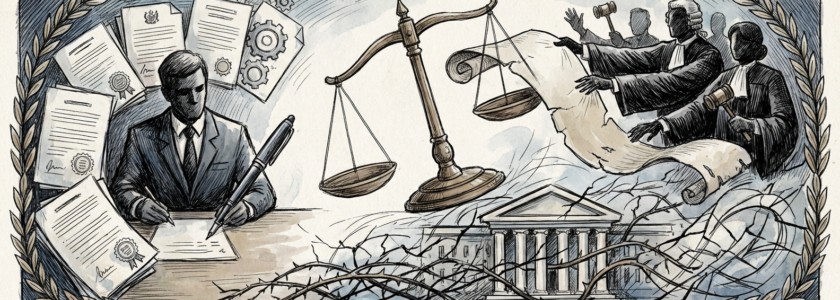
Federal judges did not sit quietly by. According to tracking by the Institute for Constitutional Advocacy and Protection at Georgetown Law, federal courts issued more than 30 injunctions against Trump administration executive actions within the first six months of 2025. These came from judges with both Democratic and Republican-appointed backgrounds, across multiple district courts and appellate panels, stopping or delaying implementation of various orders while lawsuits proceeded.

Thirty-plus injunctions is not a trivial number. It signals that courts across the country were finding serious legal problems with how these orders were being implemented or what authority they claimed. Some challenged the orders on constitutional grounds. Others contested whether the administration had followed proper procedures, considered evidence thoroughly, or acted within the bounds of existing law.

This judicial pushback was not uniform. Some injunctions were temporary, meant to preserve the status quo while a case proceeded. Others were broader and more sustained. Some judges sided with the administration completely. The point is that the courts were actively engaged in reviewing executive action at a level that specialists in constitutional law found noteworthy.

The Chevron Ruling Changed the Playing Field

To understand why these challenges succeeded at the rate they did, you need to know about a Supreme Court decision from 2024 that most people missed: Loper Enterprises v. Raimondo. In that ruling, the Court overturned something called the Chevron doctrine, which had been the legal framework for how courts reviewed regulatory decisions by federal agencies for forty years.

Under Chevron, when an agency interpreted a law and then issued rules based on that interpretation, courts would defer to the agency’s expertise as long as the interpretation was reasonable. The agency had room to work. Now, with Chevron overturned, courts review agency decisions much more skeptically. They no longer assume the agency is right. They look directly at what the law says and ask: did the agency act within its legal authority, or did it exceed it?

For lawyers challenging Trump’s executive orders, this was a game-changer. When agencies tried to implement orders through regulatory guidance or departmental instructions, challengers had a cleaner legal pathway to argue that the agencies were overreaching. At least four major challengers’ organizations specifically cited the Loper decision in their briefs against administration policies in 2025. Federal judges, in multiple cases, agreed that the old Chevron deference no longer applied.

Where the Challenges Concentrated and Won Most Often

The Congressional Research Service, which does nonpartisan analysis for Congress, examined where executive order challenges were most successful in 2025 and found something striking: immigration and federal workforce restructuring orders faced the highest rate of successful judicial challenges since the Nixon era. Two specific areas where Trump had moved decisively through executive action.

On immigration, federal courts blocked or temporarily enjoined multiple executive orders related to asylum policies, refugee processing, and enforcement priorities. On federal workforce issues, courts halted or delayed implementation of restructuring initiatives that the administration pursued through executive authority. These were not fringe victories for challengers. These were consistent, recurring legal losses for the administration in court.

The CRS report did not characterize this as good or bad. Its job is analysis, not judgment. But the data was clear: when the administration tried to implement major policy shifts through executive orders rather than through Congressional action, courts found problems at higher rates than in recent presidential history. When the administration invoked emergency powers, that rate was even higher.

Emergency Powers at Historically Elevated Levels

Speaking of emergency declarations: the Cato Institute, a libertarian think tank that scrutinizes executive power from an ideologically skeptical angle, released its 2025 Executive Power Index. The finding was that the Trump administration’s use of emergency declarations under the National Emergencies Act reached historically elevated levels in 2025. The administration invoked the act at least four separate times in its first year, compared to previous administrations that typically used it once or twice per term.

Emergency declarations matter because they unlock expansive presidential powers. When a president declares a national emergency, agencies can operate with fewer restrictions, move faster, and reallocate funds with less oversight. That is by design in some cases. The statute exists for genuine crises. But when the threshold for invoking it drops significantly, courts and legal scholars tend to ask harder questions about whether the emergency was real or whether it was being used as a shortcut around normal constitutional processes.

Multiple challengers to these emergency declarations cited the Cato analysis in their briefings to federal judges. The volume of emergency declarations, combined with the courts’ new skepticism under Loper, created conditions where judicial review of emergency powers became more intense than it had been in decades.

What This Pattern Tells Us About Executive Power Today

Look at all of this together and a coherent picture emerges. The Trump administration of 2025 came in convinced that executive action was the most efficient tool for policy implementation. It moved fast and broadly. But it did so into a legal landscape that had shifted. Courts no longer deferred automatically to agency interpretations. A major Supreme Court decision had changed the default rule. Legal advocates on multiple sides were mobilized and prepared to challenge orders through litigation.

The result was not a presidency hamstrung by courts. It was a presidency that had to litigate its way forward. Some orders stood. Some were blocked. Some were modified through the process of judicial review. This is separation of powers in practice. It is not dramatic. It is not always satisfying to people who want clear, decisive wins. But it is what the Constitution designed: no branch of government gets to act alone. Power is shared, contested, and tested in court.

If you want to understand what happened in 2025, the data resources are there for you to examine. The American Constitution Society Executive Order Tracker maintains a detailed record of orders and their legal challenges. The Congressional Research Service Reports on Executive Orders provides nonpartisan analysis of trends and outcomes. Read them. Look at the actual numbers. Form your own conclusions about whether these courts were right or wrong to block these orders. That is the point of democratic accountability.

What matters is that you know the facts. You know what actually happened. You know the legal framework that shaped outcomes. Then you can think clearly about what you believe should happen next, grounded in evidence rather than rhetoric.

How Gen Z Is Rewriting Local Democracy: The 2025-2026 Ballot Initiative Revolution

How Gen Z Is Rewriting Local Democracy: The 2025-2026 Ballot Initiative Revolution

The Quiet Revolution Nobody Expected

Something unusual happened in American cities between 2024 and 2026. While national politics commanded every news cycle and cable segment, young voters were busy remaking the actual machinery of local governance. The shift wasn’t dramatic in the way a presidential upset might be. It was slower, more methodical, and ultimately more durable. Gen Z voters didn’t just show up to elections in record numbers. They showed up with specific ideas about what ballot initiatives should accomplish and how voting itself should work.

How Gen Z Is Rewriting Local Democracy: The 2025-2026 Ballot Initiative Revolution

This matters historically because we’ve seen this pattern before, though never quite like this. The Progressive Era of the early 1900s brought us ballot initiatives and referenda as tools to bypass corrupt machine politics. The civil rights movement of the 1960s used ballot measures to challenge discriminatory laws. What’s different now is the scale of youth engagement with these mechanisms, and the speed with which they’re moving them from marginal policy concerns to mainstream political infrastructure.

We’re not talking about isolated victories in college towns. Voters aged 18 to 27 drove turnout increases of 12 to 15 percentage points over 2021 levels in major cities including Philadelphia and Denver. That’s the kind of shift that changes what’s possible on a ballot.

Illustration for How Gen Z Is Rewriting Local Democracy: The 2025-2026 Ballot Initiative Revolution

A New Generation Discovers (or Rediscovers) Ranked Choice Voting

One concrete way this generational shift is reshaping local politics involves a voting method most Americans had never heard of five years ago: ranked choice voting. In November 2025, seven new jurisdictions adopted RCV through ballot initiatives, bringing the total number of U.S. places using the system to over 60. For the uninitiated, ranked choice voting lets voters list candidates in order of preference, with votes reallocated if their first choice is eliminated. It sounds technical. It is. But Gen Z voters have embraced it as a solution to what they see as a broken system of binary political choices.

Why should you care about this? Because voting method reforms are typically the domain of political scientists and electoral nerds. They pass quietly if they pass at all. Yet Gen Z treated RCV as fundamental to their vision of more responsive local government. They organized social media campaigns. They door-knocked. They built coalitions. The FairVote Ranked Choice Voting Implementation Tracker now documents a footprint that would have seemed impossible a decade ago.

What’s revealing is how this generation talks about RCV. They don’t frame it as a technical improvement. They describe it as an antidote to feeling voiceless. In their view, a voting system that forces choices between imperfect options is a voting system that doesn’t reflect how most people actually think. That’s a philosophical position with real political consequences.

Housing, Rent, and the Rise of Local Economic Populism

If ranked choice voting represents Gen Z’s structural critique of American politics, then housing and tenant protection initiatives represent their economic one. In 2025, ballot measures protecting renters passed in Austin, Texas and Minneapolis, Minnesota, driven substantially by voter coalitions under 30 years old. These victories arrived against significant opposition from landlord associations and development interests with deep pockets and political connections.

This is worth examining through a historical lens. The tenant rights movement of the 1970s and 80s was often led by older grassroots organizers. This time, Gen Z voters are leading similar fights using digital organizing and data-driven campaign strategies. They’re using ballot initiatives because they’ve learned that city councils, responsive to development interests, won’t act without electoral pressure. It’s pragmatism born from watching housing costs consume an ever-larger share of their paychecks.

The nonprofit Vote.org registered 1.2 million new voters aged 18 to 24 in the 12 months leading up to the 2025 elections. A significant portion of those newly registered voters cited housing costs as a primary reason they were getting involved. That’s not an accident. Gen Z has lived through the housing crisis their entire politically conscious lives. They’re not debating whether it exists. They’re voting on solutions.

When Local Matters More Than National

Here’s a finding that should reshape how political professionals think about engagement: according to the Harvard Youth Poll on Political Engagement, 52 percent of Americans aged 18 to 29 now say local elections matter more to them than federal elections. That’s a fundamental reordering of political priorities for an entire generation. It suggests something the data supports: Gen Z voters have concluded that the most direct route to change runs through city hall, not Washington.

This reflects a kind of sophisticated political calculation. Federal politics feels gridlocked to them. Presidential elections feel binary and unsatisfying. But local initiatives? Those let you vote directly on policy. You can argue for or against a specific proposal without choosing between two flawed candidates. You can participate in something that actually passes or fails based on votes, not obstructed by procedural rules or partisan gridlock.

The historical echo here is to the participatory democracy movements of the late 1960s and early 1970s, when young people similarly lost faith in national institutions and redirected energy toward local community control. The difference is that this generation is doing it at scale, across multiple major cities simultaneously, with significantly more demographic diversity and organizational infrastructure.

What Happens Next

If you’re paying attention to local politics in your own community, you should expect to see more of this in 2026 and beyond. The structural and philosophical commitments Gen Z voters are making through ballot initiatives are not one-time experiments. They represent genuine changes in what young voters expect from democracy. More ranked choice voting initiatives will appear on ballots. More economic populist measures around housing, wages, and worker protections will mobilize youth voters. More civic participation will be channeled through direct democracy mechanisms rather than representative institutions.

Does this guarantee positive outcomes? No. Ballot initiatives have real limitations. They can lock in bad policy just as easily as good policy. They can be manipulated by moneyed interests through misleading campaigns. They can fragment coalition-building. But the young voters driving this movement understand these trade-offs. They’re not naive idealists. They’re pragmatists who’ve decided that direct democracy, imperfect as it is, offers a better path forward than hoping representatives will listen.

The 2025-2026 ballot initiative season is the first national-scale demonstration of Gen Z political power. It’s worth studying not as a novelty, but as evidence of how a generation that came of age during institutional crisis is redesigning institutions to match their values. The outcomes will shape local governance for years to come. If you want to understand where American democracy is actually headed, watch your city council elections more closely than the presidential race. That’s where Gen Z voters are already looking.

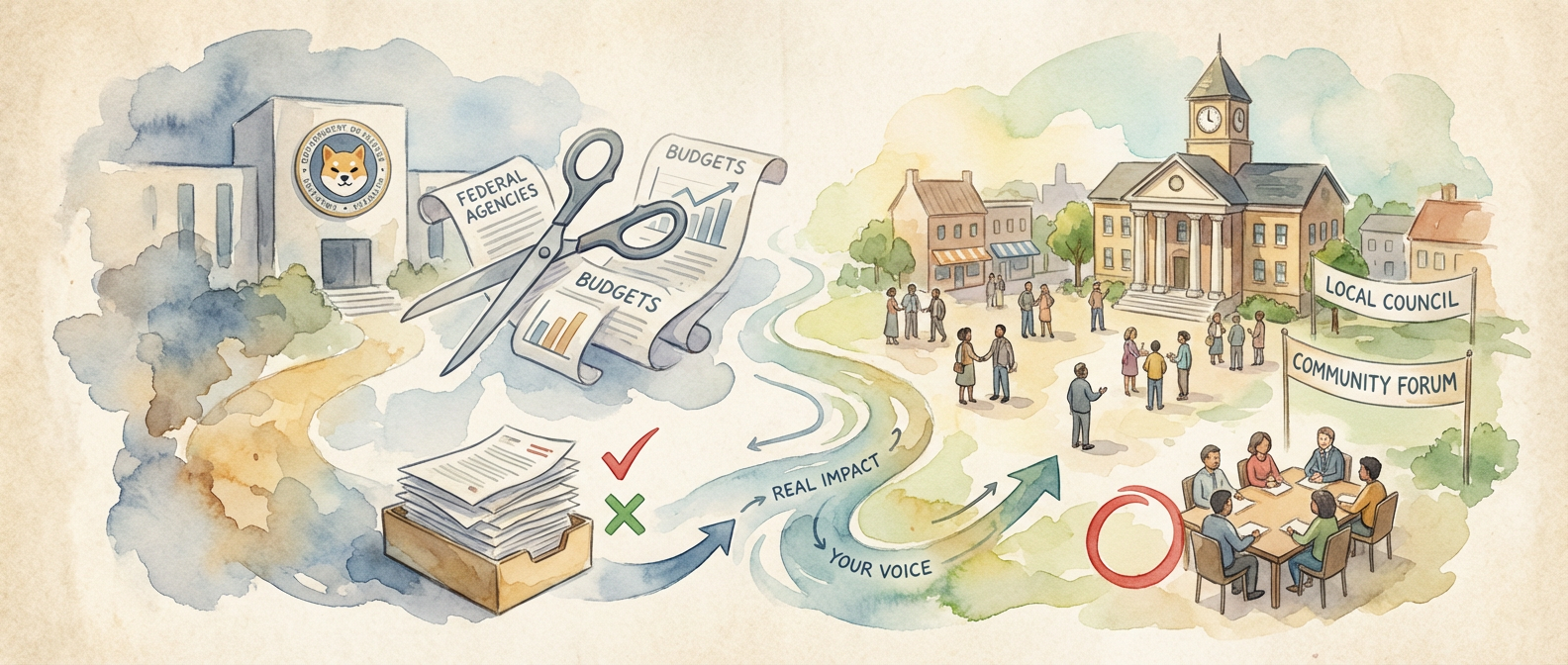
The 2025 DOGE Report Card: What the Department of Government Efficiency Actually Cut, What It Didn’t, and Why Your City Council Is the Real Battleground

The 2025 DOGE Report Card: What the Department of Government Efficiency Actually Cut, What It Didn’t, and Why Your City Council Is the Real Battleground

The Numbers That Sound Big Until You Read The Fine Print

When the Department of Government Efficiency launched in January 2025 under executive order, the headline figures were hard to ignore. Over one trillion dollars in potential federal savings identified by mid-year. That’s a number designed to stop you mid-scroll. It’s designed to feel decisive, transformative, proof that someone finally took a hard look at waste and acted. The only problem is that the Congressional Budget Office, the nonpartisan arbiter of federal spending claims, scored the actually verified savings at a fraction of that estimate. This gap between claimed and confirmed is not a small accounting detail. It’s the first and most important structural lesson: understanding what gets counted as “government efficiency” requires looking past the headline number to the methodology underneath.

The 2025 DOGE Report Card: What the Department of Government Efficiency Actually Cut, What It Didn't, and Why Your City Council Is the Real Battleground
The 2025 DOGE Report Card: What the Department of Government Efficiency Actually Cut, What It Didn’t, and Why Your City Council Is the Real Battleground

The difference between a trillion-dollar claim and the CBO’s verified figure tells you something crucial about how efficiency initiatives get framed in American political life. When you see those dramatic numbers in your news feed, ask yourself what changed in the real economy. Did your local food bank suddenly have more resources? Did your city’s infrastructure budget expand? This is not cynicism. This is structural analysis. The gap between rhetoric and results exists in how these programs measure success, and understanding that is half the battle in becoming an informed citizen.

Illustration for The 2025 DOGE Report Card: What the Department of Government Efficiency Actually Cut, What It Didn't, and Why Your City Council Is the Real Battleground
Illustration for The 2025 DOGE Report Card: What the Department of Government Efficiency Actually Cut, What It Didn’t, and Why Your City Council Is the Real Battleground

The Federal Workforce Reductions: Where the Rubber Actually Hits the Road

If the trillion-dollar claim is the headline, the federal workforce reductions are where you can actually track change happening. According to Office of Personnel Management data, approximately 75,000 federal employees accepted deferred resignation offers in the first quarter of 2025 alone. That is a real number. Real people left their jobs. That has real consequences. Some of those employees were in administrative roles where redundancy existed. Some of them were field agents, inspectors, grant administrators, and caseworkers whose positions directly affected service delivery. The problem with broad workforce reduction targets is that they are structurally indifferent to which category you’re cutting from. When you set a percentage-based reduction goal across an entire agency, you lose the ability to preserve critical functions while eliminating genuine waste.

The Congressional Budget Office Federal Workforce Analysis 2025 provides useful context here. Not all federal positions are created equal. A clerk processing paperwork operates in a different role than a Social Security disability examiner processing claims for people waiting years in the queue. Wholesale reductions do not distinguish between these roles. They work like a river flood. Water doesn’t know which buildings were built to code. It simply goes where gravity allows. In this case, gravity meant that many localities lost the human infrastructure required to administer federal programs, regardless of whether those programs themselves were efficient or not.

The Cascade Effect: Federal Cuts Become Your City’s Problem

This is where local government enters the story, and where your attention becomes genuinely urgent. The National Association of Counties documented that federal grant eliminations tied to DOGE reviews forced at least 23 states to restructure local social service delivery programs in 2025. Think about what that sentence actually means. It means that somewhere around the country, a county board had to sit down and recalculate what services they could provide their residents because the federal funds those services relied on disappeared. It means difficult conversations about whether to cut services, raise taxes, or reallocate existing budgets. It means your city council and county commissioners suddenly inherited problems that originated from decisions made 2,000 miles away.

Budget officers in Denver, Columbus, and Memphis went public with the specifics. Mid-cycle funding gaps ranging from 40 million dollars to 180 million dollars directly linked to federal program disruptions. These are not theoretical numbers. These are gaps that force real choices. Do you cut bus service? Close recreation centers? Reduce police response times? Freeze hiring for critical positions? There’s a real irony here. An efficiency initiative at the federal level became an inefficiency crisis at the local level. It’s the classic case of how systems-level problems require systems-level thinking, and when you apply a hammer at the top, the nails get driven down to the foundation.

What The Public Actually Feels: The Gap Between Belief and Experience

A Pew Research Center survey from October 2025 captured something important about how Americans are processing this. Fifty-four percent believed DOGE had some or significant impact on government waste. That is majority sentiment. That matters. But only 31 percent said federal services in their community had improved. This gap is telling you that citizens accept the theoretical case for efficiency while observing no practical benefit in their daily lives. They are watching their local government scramble to fill budget gaps. They are seeing community services disrupted. And they are being asked to believe this is all part of a coherent plan.

This gap between belief and experience is the central political fact of the moment. It suggests that efficiency narratives, no matter how well intentioned, must eventually reckon with whether they produce better service delivery at the place where citizens actually experience government. A more efficient bureaucracy that delivers less is not efficiently organized. It is differently organized, in a way that transfers burden to other actors. Whether that transfer is justified depends entirely on whether those other actors have the capacity to absorb it. Most city councils do not.

Your City Council Is Now the Real Battleground

This is where you come in, and where your attention to local politics becomes not just civically virtuous but practically necessary. The decisions that will determine whether your community emerges from this period with better service delivery or reduced service delivery are happening in city council chambers and county commission meetings. These are the venues where budget amendments get proposed. These are the meetings where you can actually understand how federal policy changes translate into local consequences. And these are the places where your voice still has proportionally more weight than it does in Washington.

I want to be direct about this. Reading about DOGE policy at the national level is useful for understanding the broader context. But understanding how that policy lands in your specific municipality requires doing the harder work of local research. Look at your city budget. Find the line items that were previously federally funded. Track which programs lost money. Show up to budget hearings. Ask your representatives what they are doing to address the gaps. This is not partisan work. This is structural work. Understanding how your government actually functions, and where the pressure points are, gives you the information you need to advocate effectively for what your community needs.

The DOGE initiative will be evaluated by historians and economists for decades. But you do not need to wait for that assessment. You can evaluate it right now by looking at whether your community’s schools, social services, and infrastructure are performing better or worse than they were before. That is the real report card. And the only people who can complete it are the ones paying attention to what your local officials are actually doing about it.

The 2025 Tariff Reckoning: Why Trump’s Trade Gambit Is Reshaping Everything We Thought We Knew About Global Economics

The April Order That Changed the Game

Let me walk you through what happened in April 2025, because understanding the mechanics matters more than accepting the headlines. The Trump administration issued an executive order imposing a 10 percent universal baseline tariff on essentially all imports entering the United States. This wasn’t casual policy. It was deliberate architecture. But here’s where it gets interesting: the order also authorized targeted tariff rates climbing as high as 145 percent on Chinese goods, creating a tiered system that made China the primary pressure point while establishing a floor for everyone else.

Now, before you dismiss this as pure protectionism, let me be fair to the administration’s framing. They argued this approach would incentivize domestic manufacturing, strengthen supply chain resilience, and recalibrate what they viewed as decades of unfavorable trade imbalances. These aren’t unreasonable concerns. Manufacturing employment matters. Supply chain vulnerability is real. The question wasn’t whether the concerns were valid. The question became whether this particular tool would solve them or create different problems.

What Happened to Global Growth When America Raised Its Wall

By October 2025, the International Monetary Fund released its World Economic Outlook and revised global growth projections downward to 2.8 percent for the year. That’s meaningful contraction from prior estimates. The IMF specifically identified U.S.-China trade fragmentation as a primary drag on growth. You can read their analysis in the IMF World Economic Outlook October 2025, and what strikes you immediately is how interconnected everything is. When the world’s largest economy and second-largest economy stop trading freely with each other, the shock radiates outward in ways that pure tariff calculations don’t capture.

Here’s the part that demands intellectual honesty: the administration wasn’t entirely wrong that trade imbalances existed. But the mechanism they chose to address those imbalances created cascading effects that hurt more people than just Chinese exporters. Supply chains built over decades don’t reconfigure overnight. Companies faced tariffs on intermediate goods they needed for production, not just final consumer products. Manufacturing costs rose. Retail prices followed. Working families felt this in their grocery bills and car payments and mortgage rates as inflation pressures emerged.

The Retaliation Nobody Expected to Move This Fast

What made 2025 genuinely historic wasn’t just American tariffs. It was how decisively other economies responded. In mid-2025, the European Union activated its Anti-Coercion Instrument for the first time. This was a tool created precisely for moments like this, and the EU deployed it against approximately 18 billion euros worth of American goods. Think about that number. That’s not symbolic. That’s economic muscle being flexed.

Our neighbors to the north and south weren’t passive either. Canada and Mexico, our partners under the USMCA framework, invoked the agreement’s dispute settlement panels over how steel and aluminum tariffs were being applied. Between May and September 2025, three separate arbitration cases were filed. This matters because USMCA was supposed to be Trump’s signature trade achievement from his first term. Now his second-term tariff approach was triggering disputes with the very countries he’d convinced to renegotiate NAFTA. The irony is uncomfortable, but it’s real.

We’ve Been Here Before: 1934 and the Lessons We Apparently Forgot

According to analysis from the Peterson Institute for International Economics Trade Analysis, the effective average U.S. tariff rate reached its highest level since 1934 by the third quarter of 2025. Think about that historical marker. 1934. That was the era of the Smoot-Hawley Tariff, which economists across the ideological spectrum view as a significant contributor to Depression-era trade collapse. We study it in textbooks as a cautionary tale about how well-intentioned trade policies can backfire spectacularly.

Now, I want to be fair again. The 2025 situation differed from 1934 in important ways. Global supply chains were more sophisticated. The Fed had more policy tools. The world had institutional frameworks like the WTO, imperfect as they are. But the core dynamic was hauntingly familiar: escalating protectionism triggering retaliatory measures, which triggered further countermeasures, which created uncertainty that businesses hated. When you’re a company deciding whether to invest in capacity or hold cash, that uncertainty is poison.

What This Means for How We Think About Trade Policy Going Forward

Here’s what I think deserves serious consideration, even if you believe the tariff strategy was fundamentally misguided. The 2025 escalation exposed real questions about how global trade is structured and who benefits from current arrangements. The administration’s grievances about trade imbalances and intellectual property theft in certain sectors weren’t fabricated. China’s industrial subsidies are real. Labor standards matter. Environmental costs matter. These are legitimate debates that deserve space in our political conversation.

But the tariff approach chose a blunt instrument when precision might have worked better. Broad-based tariffs hurt allied nations and disrupted supply chains of American manufacturers, where targeted tools addressing specific behaviors in specific sectors might have been more effective. Escalating trade disputes with Mexico and Canada made less sense than deepening economic integration with reliable partners. And betting that manufacturing would simply reshore through tariff incentives ignored what direct investment in workforce development and manufacturing infrastructure could have accomplished more efficiently.

The 2025 tariff architecture isn’t the final word on how we approach trade. It’s a data point in an ongoing conversation about how democracies balance openness with sovereignty, competition with worker protection, and long-term competitiveness with short-term employment effects. That conversation matters precisely because it doesn’t have easy answers, and pretending it does serves no one.

I’m genuinely curious what you’re observing in your own community. Are local manufacturers benefiting from tariff protection, or are they struggling with higher input costs? Are retailers dealing with supply chain disruptions or stabilization? Are you seeing jobs returning to your region, or employment uncertainty? The data from Washington and Brussels and Beijing matters, but so does what’s actually happening in neighborhoods and on shop floors. What’s your vantage point on how trade policy is landing in real economic life?

Sudan’s Forgotten War Enters Year Three: Why the World’s Largest Displacement Crisis Demands Our Attention

The Scale of Invisibility

Three years into armed conflict between the Sudanese Armed Forces and the Rapid Support Forces, the humanitarian dimensions of this war have quietly become staggering. We are looking at 11 million people displaced within Sudan’s borders, a figure that surpasses the internal displacement crisis in Ukraine and makes this the largest such crisis on the planet. Let that settle for a moment. Eleven million people forced from their homes, roughly a quarter of Sudan’s pre-war population, yet this displacement gets a fraction of the international media attention devoted to other active conflicts. This is not coincidence. It is the result of structural patterns in how global attention gets allocated, which media institutions prioritize, and which crises compete for finite donor resources and diplomatic bandwidth.

The displacement numbers tell us something crucial about the nature of this conflict. When that many people are forced from their homes, it is not the byproduct of rival armies clashing over territory in conventional ways. It reflects a deliberate strategy, systematic depopulation, and the breakdown of state capacity to protect civilians. The displacement is both symptom and weapon. That distinction matters because it shapes how we should think about what resolution might actually look like, and what international responsibility actually requires.

The Famine Crisis: Numbers That Demand Action

Humanitarian agencies have documented that approximately 8.1 million Sudanese people face emergency or catastrophic famine conditions according to December 2025 assessments. We should be direct about what this language means. The IPC Phase 4 and Phase 5 classifications represent people in acute food insecurity, families making impossible choices about whether to eat. These are not theoretical projections about what might happen. These are present-tense conditions affecting roughly a third of Sudan’s remaining population. The famine is not emerging. It is already here.

What makes this food security crisis particularly revealing about the conflict’s structural nature is that it reflects not just scarcity but the collapse of every system that moves food from producers to consumers. Markets have collapsed. Agricultural land is controlled by warring parties. Supply lines are broken. Humanitarian organizations face systematic obstacles to reaching populations in need. The World Food Programme Sudan Emergency Situation Report documents how fighting directly prevents aid delivery in precisely the areas where need is most acute. This is not a natural disaster that international aid can gradually manage. The violence itself creates and perpetuates the famine.

The Geopolitical Machinery: Why This War Persists

To understand why the conflict grinds on despite its humanitarian toll, we need to trace the structures that sustain the fighting. The Rapid Support Forces have received documented weapons and logistical support from the UAE according to UN investigative reports from late 2025. Meanwhile, Russia has used its Security Council veto on three separate occasions between January 2025 and January 2026 to block resolutions addressing Sudan, sometimes acting alone and sometimes with China. These are not peripheral details. They are the infrastructure that keeps this war functioning.

The Security Council blockade deserves scrutiny because it represents a structural failure of the international system at precisely the moment it should function. When major powers use vetoes to prevent the Council from addressing active mass atrocities and humanitarian catastrophes, they are not acting neutrally. They are choosing to let the conflict continue without the pressure that Council action would create. The UN OCHA Sudan Humanitarian Response Plan 2026 exists in a vacuum of political will. The plan itself is well-designed. The problem is diplomatic paralysis that prevents the enforcement mechanisms that might make implementation meaningful. This is a structural problem, not a technical one.

The Accountability Question: Warrants and Consequences

The International Criminal Court issued two new arrest warrants for RSF commanders in November 2025 related to mass atrocity crimes in Darfur, bringing the total active Sudan-related warrants to seven. These legal actions matter, but we should be honest about their limitations. Arrest warrants mean little when the international system lacks mechanisms to enforce them. The RSF commanders are not voluntarily appearing at The Hague. The warrants create an important formal record and provide a basis for future justice processes, but they do not immediately change the incentive structures driving ongoing conflict.

What the warrants do signal is that documentation of war crimes is occurring and that legal grounds for accountability exist. This matters beyond the immediate prosecution question. When commanders know their actions are being documented and investigated, it theoretically affects decision-making at the margins. The warrant system also preserves evidence and establishes precedent for accountability mechanisms that might emerge once the conflict is resolved. But ICC warrants, however legitimate, cannot substitute for diplomatic pressure, Security Council enforcement, or sustained international attention.

What Demands Our Engagement Now

The Sudan conflict has become a test case for whether the international community can sustain attention on crises that do not fit comfortable narratives or align with existing geopolitical interests. It tests whether humanitarian concern remains operative when major powers prefer to look away. It tests whether structural accountability mechanisms carry any real weight when proxies and strategic interests are involved.

Your role in all this is not to become an expert on Sudanese politics, though learning more would certainly help. Your role is to understand that this crisis exists within systems that respond to pressure. Media outlets decide what stories to cover based partly on demonstrated reader interest. Elected officials make statements about international crises when constituents ask about them. Donor organizations allocate resources based on visibility and advocacy. The structural invisibility of Sudan’s war is not inevitable. It reflects choices made by gatekeepers and institutions that can change if enough people decide these choices matter. Start by learning more. Share what you learn. Ask your representatives why they have not made public statements about this crisis. These are not revolutionary acts. They are the basic mechanics of how pressure gets built in democratic systems. The question is whether we choose to build it.

Why Your City Council Meeting Feels Like Theater (And How to Change That)

The Performance Problem

Last Tuesday night, I watched a resident stand at the podium for three minutes, voice shaking with frustration about potholes on Maple Street. The council members nodded politely, thanked her for coming, and moved to the next agenda item without a single question or comment. She left looking defeated. This scene plays out in municipal chambers across the country every week, and it reveals something fundamental about how public meetings actually function.

Most public meetings operate on a structural model designed for information delivery, not genuine dialogue. The agenda moves in predetermined blocks, public comment periods are time-limited, and elected officials maintain careful distance to avoid accusations of favoritism or procedural violations. Understanding this framework is the first step toward working within it effectively rather than simply performing frustration into the void.

Reading the Room Before You Enter It

Effective participation begins weeks before you step foot in that meeting room. Start by examining three months of meeting minutes on the city or county website. Look for patterns in how decisions flow from initial proposals through committee review to final votes. Notice which issues generate extended discussion versus which ones pass on consent calendars without debate.

Pay particular attention to staff reports and their recommendations. In most municipal structures, professional staff provide analysis and suggest courses of action, while elected officials choose between options rather than crafting policy from scratch. When you understand how your issue fits into existing staff priorities and budget constraints, you can frame your input in terms that connect with institutional logic rather than working against it.

Contact the relevant department head or council member’s office before the meeting. This isn’t about lobbying or special access. It’s about making sure your comments address the actual decision being made rather than adjacent concerns. I’ve seen too many passionate speakers address zoning variance requests when the council was only voting on procedural timeline extensions.

Strategic Communication Under Time Pressure

Three minutes sounds short until you’re standing at a podium with twelve eyes watching you and a red timer counting down. The reality of public comment periods means every word needs to count. Lead with your specific ask, provide one piece of compelling evidence, and close by connecting your concern to broader community interests.

Instead of: “The traffic on Elm Street is absolutely horrible and dangerous and something needs to be done immediately about this ongoing crisis that affects everyone who lives here.” Try: “I’m requesting a traffic study for the 400 block of Elm Street, where we’ve documented fifteen near-miss incidents since the school year began. Installing a crosswalk here supports the city’s stated goal of walkable neighborhoods while protecting the sixty children who cross this intersection daily.”

Bring written materials even when speaking time is limited. One-page fact sheets with your contact information can be distributed to council members before or after the meeting. Include specific data, photos if relevant, and clear action steps. These documents often prove more influential than verbal testimony because officials can reference them during deliberation periods when the public has left.

Building Beyond Single Meetings

Individual voices carry weight, but sustained pressure creates change. Elected officials respond to demonstrated constituent concern over time rather than isolated complaints. This means thinking strategically about how to build visible community support around your issue across multiple meetings and different venues.

Get neighbors to attend consecutive meetings, even if only one person speaks each time. When council members see the same faces month after month, it signals genuine community investment rather than individual grievance. Coordinate with local organizations that share your concerns. A speaker representing the Parent Teacher Association carries different institutional weight than the same person speaking as an individual resident.

Use committee meetings and work sessions strategically. These smaller gatherings often allow more interactive discussion and occur before issues reach the formal voting stage. You can learn about proposed policies while they’re still being shaped rather than trying to influence final decisions. Many municipalities also hold budget work sessions where spending priorities get debated in detail that never surfaces during regular council meetings.

Working Within Democratic Structures

The most effective public meeting participants understand that democracy operates through sustained engagement rather than single dramatic moments. Your city council meeting is one piece of a larger puzzle that includes planning commissions, school boards, county commissioners, and state representatives. Issues often move between jurisdictional levels or require coordination across multiple governing bodies.

Track your issue through this broader ecosystem. That pothole problem might require county coordination if it sits on a state route. The new development you’re concerned about probably went through planning commission review before reaching the council. Understanding these procedural pathways helps you intervene at strategic moments rather than only showing up when decisions are finalized.

Consider the electoral calendar when planning sustained advocacy. Municipal elections often see low turnout, meaning organized community groups wield disproportionate influence. Elected officials pay closer attention to constituent concerns during election years, but they also have more flexibility to take principled stands when they’re not facing immediate political consequences.

Public meeting participation works best when you approach it as civic education rather than political theater. The goal isn’t to deliver the perfect speech or score points against opponents. It’s about contributing useful information to democratic decision-making processes and building relationships that enable continued community influence over time. What would change about your local government if more people understood this distinction?

Why Voting Rights Battles Look Different in Red and Blue States (And What That Means for Your Ballot)

When Protection Becomes Politics

Last month, I watched two very different voting rights rallies unfold on the same weekend. In Phoenix, activists gathered to oppose new voter ID requirements, calling them discriminatory barriers. Three hundred miles away in Las Vegas, a similar crowd celebrated Nevada’s automatic voter registration law as a model for expanding access. Both groups claimed to be protecting democracy. Both were probably right.

This is the paradox of voting rights in 2024: the same democracy-protecting impulse produces opposite policy conclusions depending on where you live and what you think threatens the ballot box more. Republicans see fraud and push for verification. Democrats see suppression and push for access. Meanwhile, voters in the middle wonder why we can’t have both secure and accessible elections.

The Tale of Two Reforms

Consider Georgia’s 2021 election law, which became a lightning rod for voting rights debates. Critics focused on provisions like restricting ballot drop boxes and requiring ID for absentee voting. Supporters highlighted expanded early voting hours and new requirements for counties to process absentee ballots faster. Both sides cherry-picked the parts that fit their narrative, but the full picture is more complex: a law that simultaneously expanded some forms of access while restricting others.

Compare this to Vermont’s approach in 2022, when the state made permanent its pandemic-era mail voting expansions. Vermont required signature verification and maintained detailed audit procedures, but eliminated excuse requirements for mail ballots. The result? Higher turnout and zero documented cases of fraud significant enough to change any election outcome. Different methods, similar goals: elections that voters trust.

The disconnect isn’t just philosophical. In Texas, advocates spend their energy fighting voter roll purges that sometimes remove eligible voters. In Oregon, advocates focus on expanding automatic registration to reach citizens who move frequently. Both states face real challenges, but the solutions look nothing alike because the problems are different.

Where the Real Work Happens

National headlines focus on federal legislation and Supreme Court cases, but the most consequential voting rights work happens in places you’ve probably never heard of. Last year, Gwinnett County, Georgia, redesigned its ballot layout after discovering that unclear formatting led to thousands of voters skipping key races. No lawsuits, no protests, just election officials doing the unsexy work of making democracy function better.

In Maricopa County, Arizona, Republican and Democratic election observers work side by side during ballot counting, following procedures both parties helped design. They disagree on plenty, but they agree on the fundamental process. When problems arise, they solve them together rather than in court. This cooperation doesn’t make news precisely because it works.

The most effective voting rights advocacy I’ve seen happens at county commission meetings and state legislative hearings, where advocates present specific solutions to specific problems. When Minneapolis put ranked choice voting in place, activists didn’t just demand change. They ran voter education campaigns and worked with election officials on implementation details. When North Dakota’s Native American communities faced polling access issues, tribal leaders partnered with state officials to establish satellite voting locations.

Beyond the Binary

The either-or framing of voting rights debates obscures innovative solutions that address multiple concerns at once. Colorado’s election system, praised by election security experts across the political spectrum, combines universal mail voting with rigorous signature verification, paper trails, and post-election audits. Voters get convenience, officials get security, and everyone gets confidence in results.

Utah, hardly a liberal stronghold, has quietly built one of the most accessible voting systems in America while maintaining some of the strictest security protocols. They achieved this by focusing on outcomes rather than ideology: how do you maximize eligible voter participation while minimizing opportunities for fraud? The answer involved mail voting, signature verification, voter education campaigns, and extensive testing of election systems.

Even voter ID laws, the third rail of voting rights debates, show surprising variation in practice. Some states with strict photo ID requirements also provide free IDs and accept alternatives like utility bills. Others with no ID requirements maintain detailed signature verification systems. The policy details matter more than the political labels.

What This Means for Your Vote

Understanding these complexities doesn’t require abandoning your principles, but it does require moving beyond talking points. If you care about voting rights, start by learning how elections actually work in your community. Who runs your elections? What security measures are already in place? What barriers do voters actually face, versus what you assume they face?

The most effective advocates I know can explain both why we need ballot access and why we need ballot security. They understand that rural voters face different challenges than urban voters, that elderly voters have different needs than college students, that working parents need different accommodations than retirees. They build coalitions around shared values rather than shared party affiliations.

This doesn’t mean abandoning advocacy or accepting the status quo. It means recognizing that protecting voting rights requires understanding the full complexity of how elections work and who they help. Sometimes that means supporting measures that make voting easier. Sometimes it means supporting measures that make fraud harder. Usually, it means supporting both.

The next time you see a voting rights controversy in the news, ask yourself: what specific problem is this trying to solve? Are there other ways to solve the same problem? Who benefits from the current system, and who doesn’t? These questions won’t give you easy answers, but they’ll give you better ones.